
Global Equity Outlook
Market Commentary
Growth Remains Firm as Financing Costs Stay Elevated
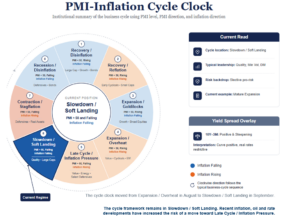
The US economy continues to expand, although growth momentum has eased. Manufacturing PMI stands at 54.6 and services at 55.4, both comfortably above the expansion threshold. Services employment, at 47.8, is the weaker part of the picture. Our cycle framework now classifies the environment as Slowdown / Soft Landing.
Inflation remains above target, and the near-term cost picture has become less favorable. August CPI rose 3.4% year over year and 0.4% for the month, while core CPI increased 0.3% month over month. Producer prices rose 5.4% over the past year. At the same time, oil prices have moved sharply higher and the 10-year Treasury yield has approached 5%. The combination raises financing costs and increases the risk that inflation remains persistent.
Corporate earnings remain strong, and the expansion provides a sound foundation for equities. Valuation is the constraint. With the S&P 500 trading at nearly 20 times expected earnings, weaker growth or disappointing profits would carry greater consequences for share prices. The economy continues to expand and earnings remain strong, but higher rates and renewed inflation pressure leave less room for disappointment at current valuations.
What the Market Environment Favors
The expansion remains favorable for equities, but elevated interest rates and valuations call for greater attention to earnings quality and the price paid for growth. Opportunities extend across regions, sectors and market capitalizations.
➔ Quality and cash flow. Companies with durable earnings, manageable debt and consistent cash generation are better positioned to absorb higher financing costs. Businesses that depend heavily on distant profit expectations may be more sensitive to changes in interest rates or growth forecasts.
➔ Valuation across market capitalizations. Reasonably priced companies can offer attractive opportunities in large-, mid- and small-cap markets. Smaller companies may benefit from improving economic conditions, although their financing costs and earnings sensitivity require closer scrutiny. Diversification across sizes reduces dependence on a narrow group of market leaders.
➔ A balanced sector approach. Economically sensitive sectors can benefit from continued expansion, while consumer staples and other defensive businesses may offer more stable demand if growth weakens. Energy remains tied to commodity prices, and utilities can be sensitive to interest rates. Sector selection should reflect earnings prospects, valuation and the risks specific to each industry.
➔ International diversification. Developed and emerging markets offer different sources of growth, valuation and currency exposure. Developed markets provide opportunities in established businesses and industries that are less represented in US indexes. Emerging markets offer exposure to domestic consumption, technology and industrial development, but require careful attention to country-specific risks. A selective approach is preferable to treating either region as a single investment opportunity.
The common discipline is to assess business quality, earnings prospects and valuation together. A sound company can still be an expensive investment, and an attractive valuation may reflect genuine business risk.
The Backdrop Behind the Market
The Economic Backdrop
The economy remains in expansion. Manufacturing PMI stands at 54.6 and services at 55.4, with the combined reading at 55.28. Six-month momentum has eased modestly, and the ISM services employment index at 47.8 points to softer hiring. The most recent official labor data are firmer: the Bureau of Labor Statistics reported on September 4 that nonfarm payrolls rose 162,000 in August and the unemployment rate held at 4.1%. The survey-based hiring measure and the payroll data are not pointing the same way, which is why employment warrants closer attention.
August CPI held at 3.4% year over year but accelerated to 0.4% month over month. Core CPI rose 0.3% for the month, while producer prices increased 5.4% from a year earlier. The more recent rise in oil prices and Treasury yields adds to that pressure. Growth remains firm, but the economy is now absorbing higher energy, input and financing costs at the same time.
Earnings Remain Strong
Profits are what the expansion rests on right now, and they delivered. With 97% of the S&P 500 having reported, 86% beat earnings expectations and 77% beat on revenue. Guidance for the current quarter is positive on balance. Ten of eleven sectors are growing earnings year over year, nine of them at double-digit rates.
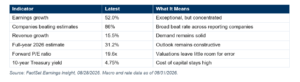
Earnings growth remains concentrated. FactSet reports 118.5% Q2 earnings growth for the Magnificent 7 against 31.8% for the other 493 S&P 500 companies. Two separate calculations are worth distinguishing. Excluding Alphabet and Amazon from the index-wide figure lowers blended S&P 500 growth from 52.0% to 33.8%; excluding the same two companies from the Magnificent 7 alone lowers that group’s growth to 43.2%. Part of their contribution comes from investment-related gains, which are included in reported GAAP earnings. Earnings are strong across the market, with an unusually large contribution from a small number of companies.
Market Conditions Remain Orderly, but Rate Risk Has Increased
Credit spreads and equity volatility remain contained, but the bond market is sending a less comfortable message. The 10-year Treasury yield briefly approached 5% following stronger inflation data, while oil remains above $100 despite retreating from its recent peak. Markets are also assigning a high probability to a Federal Reserve rate increase at the September meeting. The immediate concern is the possibility that higher rates persist while growth momentum moderates. The stock/bond correlation, measured over the trailing six months, has improved from last month but remains positive at 0.34. Bonds therefore offer some diversification, while their ability to offset equity losses is limited when both decline together.
What Could Change the Outlook
The principal risk is a combination of slower growth and persistent inflation that keeps interest rates higher for longer. At 19.6 times expected earnings, the S&P 500 remains sensitive to weaker profits or higher discount rates. Recent increases in oil prices, producer prices and Treasury yields make that risk more immediate. The indicators to monitor are:
➔ Business activity: Manufacturing and services PMIs moving toward 50, particularly alongside weaker new orders.
➔ Employment: Further deterioration in services hiring or broader labor-market data.
➔ Inflation and rates: Persistent oil and input-cost pressure feeding into broader consumer and business prices.
➔ Credit: Widening corporate spreads, which would indicate tighter financing conditions.
➔ Earnings: Downward revisions or further concentration of profit growth among a small number of companies.
➔ Market leadership: A sustained shift from cyclical to defensive sectors.
➔ Monetary policy: A series of Federal Reserve rate hikes would raise financing and refinancing costs, particularly for more leveraged companies and rate-sensitive parts of the economy.
Current market conditions remain orderly, with tight credit spreads, contained equity volatility and cyclical leadership. Those readings are consistent with continued expansion. At elevated valuations, however, maintaining earnings growth becomes increasingly important to future equity returns.
The Bottom Line
The US economy continues to expand, and corporate earnings remain strong. However, inflation pressure has become less comfortable while Treasury yields have moved toward 5%. That combination raises the cost of capital and leaves equity valuations more exposed to disappointing growth or earnings.
We remain constructive on equities, with greater attention to valuation, earnings quality and balance-sheet strength. Diversification across market capitalizations, sectors and regions remains important as the range of possible economic outcomes widens.
The key question is whether higher energy and financing costs remain temporary or begin to weigh on demand and profits. Inflation, Treasury yields, Federal Reserve policy, credit spreads and earnings revisions will be central to that assessment.
IMPORTANT DISCLAIMERS AND DISCLOSURES:
The information contained in this presentation has been gathered from sources we believe to be reliable, but we do not guarantee the accuracy or completeness of such information, and we assume no liability for damages resulting from or arising out of the use of such information. Past performance is not indicative of future results.
The views expressed in the referenced materials are subject to change based on market and other conditions. This document may contain certain statements that may be deemed forward-looking statements. Please note that any such statements are not guarantees of any future performance and actual results or developments may differ materially from those projected. Any projections, market outlooks, or estimates are based upon certain assumptions and should not be construed as indicative of actual events that will occur. The information provided herein does not constitute investment advice and is not a solicitation to buy or sell securities.
Different types of investments involve varying degrees of risk, and there can be no assurance that the future performance of any specific investment, investment strategy, investment model, or products, including the investments, investment strategies or investment themes referenced herein, will be profitable, equal any corresponding indicated historical performance level(s), be suitable for a particular portfolio or individual situation, or prove successful. Due to various factors, including changing market conditions and/or applicable laws, the content may no longer be reflective of current opinions or positions.
Please note that nothing in this content should be construed as an offer to sell or the solicitation of an offer to purchase an interest in any security or separate account. Nothing is intended to be, and you should not consider anything to be direct investment, accounting, tax, or legal advice to any one investor. Consult with an accountant or attorney regarding individual accounting, tax, or legal advice. No advice may be rendered unless a client service agreement is in place.
Procyon Advisors, LLC is a registered investment advisor with the U.S. Securities and Exchange Commission (“SEC”). This report is provided for informational purposes only and for the intended recipient[s] only. This report is derived from numerous sources, which are believed to be reliable, but not audited by Procyon for accuracy. This report may also include opinions and forward-looking statements which may not come to pass. Information is at a point in time and subject to change.
For additional information, please visit our website at www.procyon.net.