Third Quarter in Review

➜ US equities moved higher in the quarter and are now up substantially year to date.
Within large caps, the S&P 500 was up 8.1% in the quarter and now up 14.8% year to date.
Small cap stocks were even stronger in the quarter, up 12.4%, but continue not trail large cap stocks this year.
➜ International equities continued to perform extremely well with a tailwind of the weakening US dollar. These names were up 7% in the quarter and now up 26.6% year to date.
➜ Fixed income markets produced nice returns as well, with taxable bonds up 2% and municipal bonds up 3% in the quarter. Year to date, taxable bonds have outpaced municipal by 350bps (6.13% vs 2.64%) as municipals have ran into technical headwinds.
➜ The rally we have experienced over the last five months (since the tariff-related market sell-off) has been strong and wide range. In the rest of this write-up, we hope to outline our views on current economic data and our expectations going forward.
Economic Growth — Stabilizing, but still below trend
➜ The U.S. economy shows early signs of bottoming, though expansion is not yet broad-based.
➜ Manufacturing PMI edged up to 49.1, its highest in eight months, signaling slower contraction.
Production moved back into expansion (51.0), but new orders (48.9) remain weak, pointing to uneven demand.
Backlogs and exports remain soft, suggesting a late-downturn / early-recovery phase.
➜ Services PMI held near 50.0, signaling stagnation. Business activity cooled, and hiring slowed, while prices (69.4) remained elevated — evidence that inflation pressures persist even as growth moderates.
➜ Bottom Line: growth momentum is stabilizing, but the U.S. remains below trend and dependent on liquidity support.
Inflation — Re-accelerating and not yet re-anchored
➜ Headline CPI has firmed to 2.9% year-over-year, with core CPI around 3.1%, driven by sticky shelter costs and new tariff effects.
➜ The short-term annualized pace (3.5–3.7%) signals an inflation upswing, complicating the Fed’s easing trajectory.
➜ Price pressures are most evident in services and housing, while goods inflation remains subdued.
➜ Bottom Line: inflation has plateaued above the Fed’s comfort zone – it’s falling, but not fast enough to rule out policy risk.
Federal Reserve Policy — Transitioning from restrictive to reactive
➜ The Fed funds rate, near 4.0%, remains modestly restrictive in real terms but is moving toward a data-dependent easing stance.
➜ The yield curve (10Y–3M) has finally turned positive (+0.14%) after two years of inversion — a potential late-cycle pivot that historically signals recession risks are fading.
➜ Markets expect further cuts into 2026, but that depends on the trajectory of inflation.
➜ Bottom Line: policy risk remains two-sided; if inflation stalls above 3.5%, cuts could pause; if growth weakens again, cuts may accelerate.
Market Behavior — Liquidity overtaking fundamentals
➜ Despite soft macro data, U.S. equities continue to rally. The S&P 500 hit record highs (6,740), driven by AI-related mega-cap strength and expectations of policy easing.
➜ As shown in Bloomberg’s AI network chart, OpenAI, Nvidia, Microsoft, Oracle, and AMD form a dense investment web — billions in cross-investments, GPU spending, and cloud deals are reinforcing a liquidity-driven growth narrative even as real economic indicators lag.
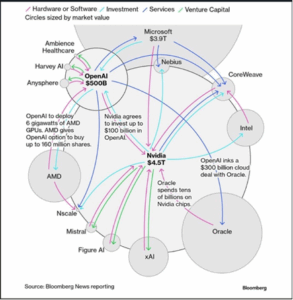
(Bloomberg AI Investment Network — October 2025)
Nvidia has pledged up to $100 billion in OpenAI.
OpenAI struck a $300 billion cloud deal with Oracle and is deploying 6 GW of AMD GPUs.
Microsoft, Oracle, and others are deeply embedded across both the hardware and software layers of the AI economy.
➜ This ecosystem has become the core engine of equity market capitalization growth, with the AI “infrastructure trade” supporting valuations even as underlying profits flatten.
Earnings and Valuation — Narrow, expensive, and fragile
➜ S&P 500 forward P/E stands at ~23x, near post-COVID highs, supported by rate-cut expectations rather than strong earnings growth.
➜ Free cash flow yield is near record lows at ~2%, below investment-grade bond and Treasury yields — implying a compressed equity risk premium.
➜ Earnings concentration remains extreme:
The “Mag7” account for ~33% of market cap but only ~25% of EPS (OP/MKT ≈ 0.77).
Financials, Energy, and Communication Services are over-earning relative to size, while Tech’s earnings share lags its valuation weight.
➜ With PMIs below 50 and margins peaking, equities are vulnerable to multiple compression if growth or earnings disappoint.
Risk Environment — Improving tone, fragile balance
➜ Our proprietary risk composite shows a mild uptick (+0.64), signaling rising but contained risk.
➜ Volatility and liquidity metrics have improved since Q2, but policy and geopolitical uncertainty remain dominant.
➜ Financial markets are loosening ahead of policy, with equities and credit spreads reflecting early-recovery optimism, even as credit growth and small business lending stay weak.
Why Markets Rally Despite Late-Cycle Signals
① Markets lead the economy — investors are pricing an early recovery 6–9 months ahead.
② Liquidity beats macro — easing and slower quantitative tightening lowers discount rates, inflating valuations.
③ Performance chasing — defensive managers are re-risking amid FOMO-driven rallies.
④ Narrative power — the “Soft Landing + AI Productivity + Fed Put” story coupled with a stock market motivated government, keeps sentiment high.
④ Valuation-driven rally — EPS growth is flat, but higher P/Es lift index levels, echoing prior “liquidity repricing” cycles (1995, 2019).
Our Outlook — Policy-led stabilization with valuation risk
➜ Base case: sub-trend growth (~1.5–2.0%), mild disinflation, and ongoing Fed easing into 2026.
➜ Best case: inflation falls faster, enabling more cuts and sustained AI-led capex momentum.
➜ Risk case: inflation re-accelerates; yield curve steepens for the wrong reasons (higher term premia).
➜ Positioning view:
We remain constructive but cautious given valuations.
We prefer quality balance sheets and cash flow visibility over speculative beta.
We are watching for data reversion once shutdown-delayed releases resume.
In short
① Markets are celebrating rate cuts and AI optimism, not broad economic strength.
② Growth is stabilizing but fragile; inflation is sticky; policy is reactive; valuations are stretched.
③ When real data resumes, volatility could rise as sentiment meets fundamentals.
Sources | IMPORTANT DISCLAIMERS AND DISCLOSURES:
Procyon Macro & TAA Review; Bloomberg; Reuters; Federal Reserve
The information contained in this report has been gathered from sources we believe to be reliable, but we do not guarantee the accuracy or completeness of such information. Nothing herein is intended to waive or limit any right a client may have under federal or state securities laws. Past performance is not indicative of future results.
The views expressed in this report are the opinions of Procyon Advisors, LLC as of the date of publication and are subject to change without notice based on market and other conditions. This document contains opinions and forward-looking statements. Please note that any such statements are not guarantees of any future performance and actual results or developments may differ materially from those projected. Any projections, market outlooks, or estimates are based upon certain assumptions and should not be construed as indicative of actual events that will occur. The information provided herein is general in nature, is not tailored to the investment needs of any particular investor, does not constitute individualized investment advice and is not a solicitation to buy or sell securities.
Different types of investments involve varying degrees of risk, and there can be no assurance that the future performance of any specific investment, investment strategy, investment model, or products, including the investments, investment strategies or investment themes referenced herein, will be profitable, equal any corresponding indicated historical performance level(s), be suitable for a particular portfolio or individual situation, or prove successful. Due to various factors, including changing market conditions and/or applicable laws, the content may no longer be reflective of current opinions or positions. Investing involves risk, including the possible loss of principal.
Topic-specific risks. Fixed income investments are subject to interest-rate risk (bond prices generally fall as interest rates rise), credit risk, inflation risk, call risk and liquidity risk. Value and growth investment styles may each underperform the broader market, and a value-oriented approach may hold securities that remain undervalued for an extended period. Low-volatility strategies may lag in strongly rising markets and do not eliminate the risk of loss. Smaller companies may be more volatile and less liquid than larger companies. International investments involve additional risks, including currency fluctuation, political and economic instability, and differing accounting and regulatory standards. Concentrating investments in a sector or theme, such as technology or artificial intelligence, may increase volatility and the risk of loss. Diversification and asset allocation do not ensure a profit or protect against loss.
Index and third-party data. The S&P 500 Index is unmanaged and cannot be invested in directly; index returns do not reflect fees, expenses or transaction costs. Third-party data (FactSet, S&P Global Compustat, the Institute for Supply Management and the U.S. Bureau of Labor Statistics) are believed to be reliable but have not been independently verified by Procyon and are subject to the providers’ terms and conditions. Analyst forecasts and consensus estimates are opinions of third parties, may change without notice and may not be realized.
Please note that nothing in this content should be construed as an offer to sell or the solicitation of an offer to purchase an interest in any security or separate account. Nothing is intended to be, and you should not consider anything to be direct investment, accounting, tax, or legal advice to any one investor. Consult with a qualified investment professional, accountant or attorney regarding your individual investment, accounting, tax or legal situation. No advice may be rendered unless a client service agreement is in place.
Procyon Advisors, LLC is an investment adviser registered with the U.S. Securities and Exchange Commission (“SEC”). Registration does not imply a certain level of skill or training. This report is provided for informational purposes only and for the intended recipients only and may not be reproduced or redistributed without Procyon’s written consent. This report is derived from numerous sources, which are believed to be reliable, but not audited by Procyon for accuracy. This report also includes opinions and forward-looking statements which may not come to pass. Information is at a point in time and subject to change without notice.
For additional information, please visit our website at www.procyon.net. Procyon’s Form ADV Part 2A, which describes its services, fees and conflicts of interest, is available upon request.