
Welcome OLV Investment Group clients. We are honored to have you join the Procyon community.


Author: Antonio Rodrigues

Over the weekend, the U.S. and Israel launched coordinated military strikes against Iran, targeting senior leadership, military infrastructure, and components of its nuclear program. Iran’s Supreme Leader has reportedly been killed, and Iran has responded with missile and drone attacks across the region. President Trump has labeled the campaign “Operation Epic Fury,” with the stated objective of regime change in Tehran. Strikes are expected to continue, and there are already reports of U.S. casualties.

First and foremost, the human element matters. The safety of civilians and our troops is paramount. These are serious developments with real-world consequences.

At the same time, as investors, we have to assess what this means for markets, not emotionally, but analytically.

When geopolitical shocks occur, markets typically react through three primary channels: risk sentiment shifts, energy prices move, and volatility rises. The key question is not whether markets react — they always do. The key question is whether this evolves into a sustained macroeconomic shock, or remains a contained geopolitical escalation with temporary market implications.


This Was Building

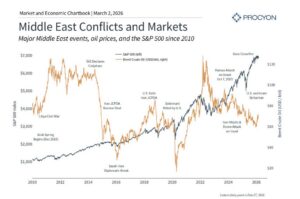
While the scope of the strikes is significant, particularly the targeting of Iran’s senior leadership, tensions did not appear overnight.

Iran’s adversarial posture toward the U.S. and Israel has spanned decades. In 2019, Iran attacked Saudi oil infrastructure, temporarily disrupting global supply. Hamas’ October 2023 attack on Israel reignited broader regional conflict and heightened direct tensions with Iran. Last summer, Israel conducted a 12-day campaign targeting Iranian nuclear and missile assets. Nuclear negotiations failed in recent months, and a visible U.S. military buildup suggested escalation risk was rising.

In other words, this was a progression, not a bolt from the blue. Markets tend to struggle with true surprises. They often digest well-telegraphed risks more effectively than feared. We saw this in the market’s resilience in the Monday following the attacks.

The Energy Transmission Mechanism

For markets, the most direct variable is oil. Iran produces roughly 3 million barrels per day and sits along the Strait of Hormuz — one of the most critical energy chokepoints in the world. Roughly one-third of global seaborne oil exports pass through that narrow corridor. Even the threat of dis­ruption can push prices higher.

Following the strikes, WTI moved into the low $70s and Brent approached $80. That’s a clear reaction, but context matters.

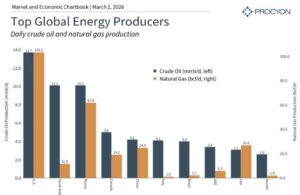
Oil peaked near $128 in 2022 following Russia’s invasion of Ukraine. We are materially below those levels today. More importantly, the structural backdrop has shifted. The U.S. is now the world’s largest producer of oil and natural gas. While we remain part of a global energy market, domestic production meaningfully reduces vulnerability relative to prior decades.

Energy shocks become economically problematic when they are severe, sustained, and layered on top of fragile growth. At present, none of those conditions are clearly in place. Could they develop? Yes. Is that the base case? No.

We saw a similar dynamic in 2022 where consensus expected structurally higher oil prices for years. Instead, supply adjusted and prices normalized faster than projected.

What History Tells Us

A common behavioral mistake during geopolitical crises is extrapolation. Assuming that severe headlines translate into permanent market damage.

History does not support that view.

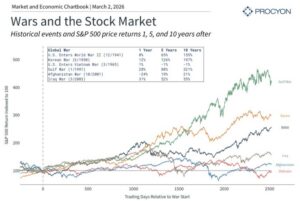
Markets have navigated world wars, the Gulf War, 9/11, the wars in Iraq and Afghanistan, Russia’s invasion of Ukraine, and the Israel–Hamas conflict. Each episode brought volatility. None permanently derailed long-term market compounding.

Markets ultimately price earnings, liquidity, policy, and productivity. Geopolitical events matter to the extent that they alter those drivers.

In many historical cases, markets bottomed while headlines remained negative. Waiting for clarity has often meant missing the recovery.
Portfolio Impact

It’s also important to separate emotional intensity from portfolio exposure.

Iran has been under heavy sanctions for years, and its economy is relatively isolated from global capital markets. Direct exposure within diversified portfolios is minimal.

The real risks are second-order: sustained energy inflation, shipping disruptions, broader regional escalation, or policy responses that tighten financial conditions. Those are macro variables we will be monitoring.

Our portfolios are built across asset classes, sectors, and geographies precisely because we cannot predict which shock will arrive next. Diversification is not theoretical — it is structural risk management.

Discipline Matters – Final Thoughts

Events like this test discipline more than analysis.

Military conflict carries emotional weight. But investment decisions made in emotionally charged environments tend to be the most costly.

Short-term volatility is uncomfortable. Permanent capital impairment is expensive.

The data is clear: missing even a handful of the market’s strongest days materially reduces long-term returns. Those days often occur during peak uncertainty.
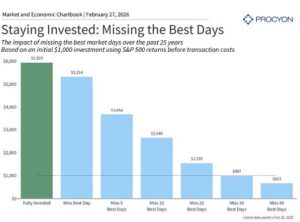
This does not mean ignoring risk. It means distinguishing between headline risk and structural economic deterioration. Right now, we are firmly in the headline phase.

The strikes on Iran represent a meaningful geopolitical escalation. The situation is fluid, and we are monitoring developments closely.

However, our framework does not change based on headlines. Diversified portfolios aligned with long-term financial plans are designed to endure periods of uncertainty.

We cannot predict every shock, but we can prepare for them through disciplined portfolio construction.

Discipline — not reaction — is what compounds wealth over time.


IMPORTANT DISCLAIMERS AND DISCLOSURES:

The information contained in this presentation has been gathered from sources we believe to be reliable, but we do not guarantee the accuracy or completeness of such information, and we assume no liability for damages resulting from or arising out of the use of such information. Past performance is not indicative of future results.

The views expressed in the referenced materials are subject to change based on market and other conditions. This document may contain certain statements that may be deemed forward‐looking statements. Please note that any such statements are not guarantees of any future performance and actual results or developments may differ materially from those projected. Any projections, market outlooks, or estimates are based upon certain assumptions and should not be construed as indicative of actual events that will occur. The information provided herein does not constitute investment advice and is not a solicitation to buy or sell securities.

Different types of investments involve varying degrees of risk, and there can be no assurance that the future performance of any specific investment, investment strategy, investment model, or products, including the investments, investment strategies or investment themes referenced herein, will be profitable, equal any corresponding indicated historical per­formance level(s), be suitable for a particular portfolio or individual situation, or prove successful. Due to various factors, including changing market conditions and/or applicable laws, the content may no longer be reflective of current opinions or positions.

Please note that nothing in this content should be construed as an offer to sell or the solicitation of an offer to purchase an interest in any security or separate account. Nothing is intended to be, and you should not consider anything to be direct investment, accounting, tax, or legal advice to any one investor. Consult with an accountant or attorney regarding individual accounting, tax, or legal advice. No advice may be rendered unless a client service agreement is in place.

Procyon Advisors, LLC is a registered investment advisor with the U.S. Securities and Exchange Commission (“SEC”). This report is provided for informational purposes only and for the intended recipient[s] only. This report is derived from numerous sources, which are believed to be reliable, but not audited by Procyon for accuracy. This report may also include opinions and forward-looking statements which may not come to pass. Information is at a point in time and sub­ject to change.

For additional information, please visit our website at www.procyon.net.
EXECUTIVE SUMMARY

The U.S. economy is transitioning from a narrow, services-led disinflationary expansion to a broader growth regime marked by a manufacturing rebound, persistent inflation friction, and an expansion of corporate earnings participation. After a prolonged contraction, manufacturing activity has re-entered expansion, driven by a decisive recovery in demand.

Financial markets reflect this shift: the yield curve has re-steepened on improving growth expectations, and the “earnings gap” between mega-cap tech and the broader market is closing. This regime favors cyclical participation and disciplined factor rotation over duration-driven valuation expansion.


MANUFACTURING: A DEMAND-LED INFLECTION

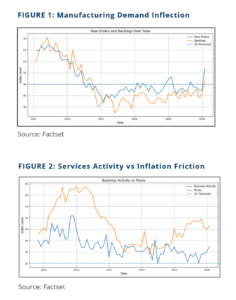
The January manufacturing PMI rose to 52.6, marking a clear exit from contraction. This rebound is supported by New Orders at 57.1 and Backlogs at 51.6, confirming that demand acceleration is genuine rather than inventory-driven.

Historically, the simultaneous rise of New Orders and Backlogs above 50 has preceded acceleration in industrial production. While manufacturing employment remains cautious (48.1), the surge in orders suggests a transition from a services-only expansion toward a more balanced growth mix.

SERVICES: RESILIENT, BUT INFLATION-CONSTRAINED

Services activity remains firmly expansionary (PMI 53.8). However, prices paid surged to 66.6, indicating re-accelerating cost pressures. Unlike traditional demand-pull inflation, current services inflation is increasingly structural, driven by labor shortages in specialized sectors and rising energy intensity from AI-related infrastructure. These indices suggest that inflation is stabilizing above target, creating an asymmetric environment that constrains Federal Reserve easing.

The Corporate Earnings Outlook: Breadth Returns

The macro shift into manufacturing and resilient services is manifesting in a significant broadening of corporate fundamentals. For the full year 2026, S&P 500 earnings growth is projected at 14.1%–15.0%, marking what would be the third consecutive year of double-digit gains.

Closing the “Earnings Gap”

The defining characteristic of 2026 is the participation of the broader market. While the “Magnificent 7” continue to lead with 22.7% projected growth, the S&P 493 (the rest of the index) is expected to accelerate to 12.5%. This would confirm that the earnings recession for mid-to-large-cap cyclicals has effectively ended.

Margin Resilience & Productivity

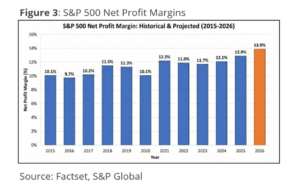
Despite rising input costs, net profit margins are forecasted to reach a record 13.9%. This is driven by two primary factors:

      1. AI Implementation: Transitioning from pilot stages to production-level automation in manufacturing and back-office functions.
      2. Pricing Power: Specifically in the Industrials and Materials sectors, where companies are successfully passing through costs as demand outstrips supply.

Monetary Policy and the Yield Curve

The yield curve’s re-steepening to approximately +55 bps (10y–3m) reflects growth-driven dynamics rather than policy accommodation. With growth broadening and input-cost pressures elevated, aggressive easing risks reigniting inflation. The most likely policy path is “higher-for-longer” rates with gradual, data-dependent cuts.

With Chairman Powell’s term at the Federal Reserve ending in May, President Trump’s pick to replace him, Kevin Warsh, is likely to take over. Warsh is viewed as a more financial market friendly pick, but will undoubtably have to toe the line between further accommodation and rising inflation risks.

Market Volatility and Risk Regime

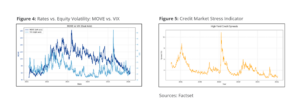
Market signals confirm an orderly transition. Equity volatility has risen modestly but remains below systemic risk levels. Bond market volatility is near historical troughs, indicating rate uncertainty is well-anchored. Credit spreads remain comfortably below stress thresholds, signaling rotation within risk assets rather than a broad exit from the market.

Translating the Regime into Equity Portfolio Construction

This macro regime – broadening growth with inflation friction – calls for a rotation toward “Earnings Realization” over “Valuation Expansion.

  • Reduce Concentration in Long-Duration Growth: High valuations and discount-rate sensitivity limit upside in mega-caps.
  • Increase Selective Exposure to Cyclicals & Value: Specifically, Industrials and Materials, which benefit from manufacturing momentum and have seen positive earnings revisions of 28.6%.
  • Broaden Market Cap Participation: Mid- and small-cap equities offer greater sensitivity to domestic growth and less reliance on multiple expansion.
  • Maintain Quality as an Anchor: Emphasize profitability and balance-sheet strength to navigate a “higher-for-longer” interest rate environment.

Conclusion

The U.S. economy is entering a new phase defined by manufacturing re-engagement and an earnings recovery that is finally reaching the broader index. For investors, the challenge is not an imminent recession but adapting to a world where returns depend less on the Federal Reserve and more on earnings delivery, factor rotation, and industrial productivity.

Third Quarter in Review:

  • US equities moved higher in the quarter and are now up substantially year to date.
    • Within large caps, the S&P 500 was up 8.1% in the quarter and now up 14.8% year to date.
    • Small cap stocks were even stronger in the quarter, up 12.4%, but continue not trail large cap stocks this year.
  • International equities continued to perform extremely well with a tailwind of the weakening US dollar. These names were up 7% in the quarter and now up 26.6% year to date.
  • Fixed income markets produced nice returns as well, with taxable bonds up 2% and municipal bonds up 3% in the quarter. Year to date, taxable bonds have outpaced municipal by 350bps (6.13% vs 2.64%) as municipals have ran into technical headwinds.
  • The rally we have experienced over the last five months (since the tariff-related market sell-off) has been strong and wide range. In the rest of this write-up, we hope to outline our views on current economic data and our expectations going forward.


Economic Growth — Stabilizing, but still below trend

  • The U.S. economy shows early signs of bottoming, though expansion is not yet broad-based.
  • Manufacturing PMI edged up to 49.1, its highest in eight months, signaling slower contraction.
    • Production moved back into expansion (51.0), but new orders (48.9) remain weak, pointing to uneven demand.
    • Backlogs and exports remain soft, suggesting a late-downturn / early-recovery phase.
  • Services PMI held near 50.0, signaling stagnation. Business activity cooled, and hiring slowed, while prices (69.4) remained elevated — evidence that inflation pressures persist even as growth moderates.
  • Bottom Line: growth momentum is stabilizing, but the U.S. remains below trend and dependent on liquidity support.


Inflation — Re-accelerating and not yet re-anchored

  • Headline CPI has firmed to 2.9% year-over-year, with core CPI around 3.1%, driven by sticky shelter costs and new tariff effects.
  • The short-term annualized pace (3.5–3.7%) signals an inflation upswing, complicating the Fed’s easing trajectory.
  • Price pressures are most evident in services and housing, while goods inflation remains subdued.
  • Bottom Line: inflation has plateaued above the Fed’s comfort zone – it’s falling, but not fast enough to rule out policy risk.


Federal Reserve Policy — Transitioning from restrictive to reactive

  • The Fed funds rate, near 4.0%, remains modestly restrictive in real terms but is moving toward a data-dependent easing stance.
  • The yield curve (10Y–3M) has finally turned positive (+0.14%) after two years of inversion — a potential late-cycle pivot that historically signals recession risks are fading.
  • Markets expect further cuts into 2026, but that depends on the trajectory of inflation.
  • Bottom Line: policy risk remains two-sided; if inflation stalls above 3.5%, cuts could pause; if growth weakens again, cuts may accelerate.


Market Behavior — Liquidity overtaking fundamentals

  • Despite soft macro data, U.S. equities continue to rally. The S&P 500 hit record highs (6,740), driven by AI-related mega-cap strength and expectations of policy easing.
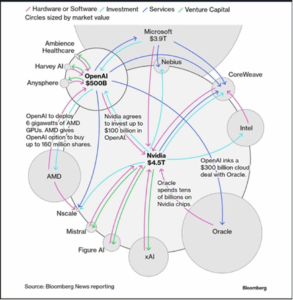
  • As shown in Bloomberg’s AI network chart, OpenAI, Nvidia, Microsoft, Oracle, and AMD form a dense investment web — billions in cross-investments, GPU spending, and cloud deals are reinforcing a liquidity-driven growth narrative even as real economic indicators lag.


(Bloomberg AI Investment Network — October 2025)


    • Nvidia has pledged up to $100 billion in OpenAI.
    • OpenAI struck a $300 billion cloud deal with Oracle and is deploying 6 GW of AMD GPUs.
    • Microsoft, Oracle, and others are deeply embedded across both the hardware and software layers of the AI economy.
  • This ecosystem has become the core engine of equity market capitalization growth, with the AI “infrastructure trade” supporting valuations even as underlying profits flatten.


Earnings and Valuation — Narrow, expensive, and fragile

  • S&P 500 forward P/E stands at ~23x, near post-COVID highs, supported by rate-cut expectations rather than strong earnings growth.
  • Free cash flow yield is near record lows at ~2%, below investment-grade bond and Treasury yields — implying a compressed equity risk premium.
  • Earnings concentration remains extreme:
    • The “Mag7” account for ~33% of market cap but only ~25% of EPS (OP/MKT ≈ 0.77).
    • Financials, Energy, and Communication Services are over-earning relative to size, while Tech’s earnings share lags its valuation weight.
  • With PMIs below 50 and margins peaking, equities are vulnerable to multiple compression if growth or earnings disappoint.


Risk Environment — Improving tone, fragile balance

  • Our proprietary risk composite shows a mild uptick (+0.64), signaling rising but contained risk.
  • Volatility and liquidity metrics have improved since Q2, but policy and geopolitical uncertainty remain dominant.
  • Financial markets are loosening ahead of policy, with equities and credit spreads reflecting early-recovery optimism, even as credit growth and small business lending stay weak.


Why Markets Rally Despite Late-Cycle Signals

  1. Markets lead the economy — investors are pricing an early recovery 6–9 months ahead.
  2. Liquidity beats macro — easing and slower quantitative tightening lowers discount rates, inflating valuations.
  3. Performance chasing — defensive managers are re-risking amid FOMO-driven rallies.
  4. Narrative power — the “Soft Landing + AI Productivity + Fed Put” story coupled with a stock market motivated government, keeps sentiment high.
  5. Valuation-driven rally — EPS growth is flat, but higher P/Es lift index levels, echoing prior “liquidity repricing” cycles (1995, 2019).


Our Outlook — Policy-led stabilization with valuation risk

  • Base case: sub-trend growth (~1.5–2.0%), mild disinflation, and ongoing Fed easing into 2026.
  • Best case: inflation falls faster, enabling more cuts and sustained AI-led capex momentum.
  • Risk case: inflation re-accelerates; yield curve steepens for the wrong reasons (higher term premia).
  • Positioning view:
    • We remain constructive but cautious given valuations.
    • We prefer quality balance sheets and cash flow visibility over speculative beta.
    • We are watching for data reversion once shutdown-delayed releases resume.


In short:

  1. Markets are celebrating rate cuts and AI optimism, not broad economic strength.
  2. Growth is stabilizing but fragile; inflation is sticky; policy is reactive; valuations are stretched.
  3. When real data resumes, volatility could rise as sentiment meets fundamentals.


Sources:

Procyon Macro & TAA Review; Bloomberg; Reuters; Federal Reserve


Although the US economy has been resilient, the effect of higher rates and trade wars has not been evenly distributed. The concentrations of both capital investment and subsequent earnings continue to build in the tech sector despite a stricter borrowing environment and more difficult global trade.

We see the S&P, NASDAQ and DOW all hitting record highs, home prices hitting all-time highs, bitcoin and gold, all at all-time highs and CPI sitting at 2.9% over the last twelve months. What would cause the fed and US investors to ask for rate cuts? The fed appears to remain focused on their dual mandate of full employment and moderate inflation.


Employment softening: Bouncing from historic low unemployment, but with a clear trend.

  • Unemployment at 4-year high, 4.3%
  • Downward revision of 911k less jobs created over 12 months period ending 3/31/25.
  • Job creation for August was 22k, a sharp decline from previous months.
  • Firms most affected by higher rates and tariffs are smaller companies who are finding it difficult to hire.


Inflation: Sticky but under control.

  • CPI is up 2.9% over the last 12 months
  • Shelter & Food – Biggest drivers of inflation over the past year, with rising rents and higher prices for meats, poultry, and dining out.
  • Energy & Services – Mixed impact: gasoline fell, but electricity, natural gas, and healthcare costs added pressure

As the fed governors debate these points internally, they have decided to cut the target fed funds rate by .25% to a new target of 4.00-4.25%. The signal from Chair Jerome Powell is that the fed’s goal of full employment has shifted in importance versus inflation in the last few months, and that going forward more cuts are expected.

The fed’s reaction to the softening labor market should be encouraging to workers and investors as it shows confidence that inflationary pressures have largely passed and they can count on full-on support for labor in the near-term.


Sources:

Bureau of Labor Statistics: https://www.bls.gov/cpi/
Y Charts: https://ycharts.com/


On the surface, the second quarter of 2025 was a blockbuster quarter for equity markets. U.S. and international equities surged over 10%, driven by a powerful rally that took hold in April and rarely let up. Small caps lagged but still posted a solid 8.5% gain.

Taxable fixed income finished slightly positive, while municipals drifted modestly lower.

If you only looked at the numbers, you’d assume investors spent the quarter embracing risk with confidence. But markets rarely move in straight lines—and this quarter’s strength masked a rollercoaster of volatility, uncertainty, and geopolitical shock. While the final story is written above, the chapters that follow offer deeper perspective on what shaped Q2 and where we go from here.

Chapter 1: Tariffs Return with a Vengeance (and So Does Volatility)

The tone for Q2 was set even before it officially began. Markets spent much of Q1 trading lower in anticipation of a shift in U.S. trade policy, and on April 2nd, those fears were realized. In a dramatic speech, former President Trump declared “Liberation Day,” where he announced sweeping tariffs on nearly all imports from countries where the U.S. ran a trade deficit.

Markets responded sharply. U.S. equities plunged, with the S&P 500 dropping nearly 19% from its February peak to the early April trough. The VIX (volatility index) spiked above 50—levels not seen since the pandemic panic of 2020. International markets held up slightly better thanks to a weaker U.S. dollar, but still fell close to 14% from their highs.

The sudden shift in trade policy not only rattled markets—it created deep uncertainty for business leaders and research analysts. With little clarity on the scope or duration of tariffs, many companies began pausing investment plans. We expect these effects to echo through the second half of the year as firms reevaluate capital allocation and supply chain strategies.

Chapter 2: A Pause, Progress, and Promises

Just one week after Liberation Day, the narrative shifted again. On April 9th, President Trump surprised markets by announcing a 90-day pause on the newly announced tariffs. The move was framed as a goodwill gesture to allow space for ongoing trade negotiations, some of which had begun bearing fruit behind the scenes.

The market response was euphoric. The S&P 500 experienced its strongest single-day rally in years, and risk appetite returned with force. From the trough on April 8th to the end of the quarter, major equity indices climbed over 24%.

The 90-day pause was not a resolution, but it was a release valve. It gave markets breathing room and helped anchor the view that extreme trade policy outcomes may be used more for leverage than legislation. While risks remain, investors grew increasingly confident that future tariff headlines would be more bark than bite. That being said, baseline tariffs of 10% remain in place and will have impact on earnings and business investment going forward.


Chapter 3: Powell Holds in the Face of Political Pressure

Coming into the year, markets were pricing in rate cuts by mid-2025. But strong labor market data (unemployment at 4.1%) and inflation that remained above target (Core PCE at 2.7%) kept the Fed firmly on hold.

Chairman Powell and the FOMC opted to stay patient, resisting growing political pressure from President Trump, who has been vocally critical of the Fed’s hesitancy to cut. The Fed’s stance remained cautiously restrictive, aiming to keep inflation on its path toward 2% without jeopardizing the broader economy.

With policy uncertainty (especially on trade and fiscal fronts) still swirling, a wait-and-see attitude is appropriate. The Fed continues to hold a slightly restrictive policy stance, which we believe is appropriate given the economic conditions. Going forward, the Fed finds itself walking a tightrope—balancing economic resilience with political noise, and data dependency with global risk factors.


Chapter 4: Missiles Fly, Markets Hold

Perhaps the most surprising chapter of Q2 came in mid-June, when geopolitical tensions flared dramatically. Israel launched coordinated strikes on Iranian nuclear sites, followed days later by a U.S. air campaign coined Operation Midnight Hammer.

Oil prices surged more than 10% overnight, and headlines warned of a broader regional war. But markets barely blinked. Iran threatened retaliation but ultimately refrained, as President Trump brokered a ceasefire that de-escalated tensions.

By quarter’s end, energy prices had fully retraced their gains, and equities continued their march higher. The market’s muted reaction was a testament to investor focus on fundamentals and a belief that the conflict would remain contained. It was also a reminder of one of our core beliefs: time in the market beats timing the market.


Epilogue: The Story Continues

We’ve already seen significant developments in the early days of Q3. Most notably, the Big Beautiful Bill—a sweeping piece of fiscal legislation—was signed into law on July 4th. The bill includes tax cuts, infrastructure spending, and energy policy changes, and while its full impact will take time to unfold, it’s expected to add meaningfully to the national debt.

The bill comes after Moody’s downgraded the U.S. credit rating in Q2—a sign that debt levels are beginning to catch up with fiscal optimism. As a result, we anticipate higher rates on the long end of the yield curve. The curve remains slightly inverted, but we expect a combination of modest Fed cuts and rising long-term yields to push it toward normalization in the months ahead.

From a macro perspective, we remain constructive. Inflation is moderating, employment remains tight, earnings are resilient, and financial conditions are stable. A more accommodative central bank paired with pro-growth policy may continue to support risk assets. But with rising divergence across market caps, sectors, and styles, selectivity matters more than ever.


Our Positioning

We continue to emphasize broad diversification as essential tools in this market:

  • International equities have shown long-awaited leadership after a decade of underperformance.
  • Value stocks led early in the year, but growth roared back after April’s lows.
  • Small caps still trail, but falling rates and tax relief could act as a catalyst.
  • Fixed income has played its role as portfolio ballast during equity drawdowns, particularly in March and early April.

Passive index exposure and concentrated sector/company bets may have worked in recent years—but going forward, we see growing risk in narrow exposures. Discipline, diversification, and a long-term view remain your greatest allies in this fast moving market environment.

Strategic Macro Themes: Navigating a Shifting Global Landscape

As global capital flows continue to realign across economies and corporate balance sheets, our team is closely tracking several critical macroeconomic and geopolitical developments. Below is a summary of the key themes shaping our strategic outlook:

Trade Realignments and the “Chexit” Era

Shift Away from China

The U.S. has significantly reduced direct trade with China, redirecting flows to countries such as Mexico, Vietnam, and India. These nations increasingly serve as intermediaries in supply chains that still rely on Chinese components.
In response, China is deepening trade ties with emerging markets across Africa, Latin America, and Southeast Asia to diversify away from Western markets.

Rise of Economic Nationalism

In 2025, the U.S. imposed sweeping new tariffs1:

  • 30% on most Chinese imports, with exceptions like smartphones at 20%.
  • 25% on steel, aluminum, and non-USMCA-compliant goods from Mexico and Canada.
  • 10% baseline tariffs on most other imports, including from the EU.

These tariffs are framed as reciprocal and based on trade deficit ratios, not purely retaliatory.
Legal challenges were initially successful, but an emergency appeal reinstated the tariffs.

Friendshoring and Nearshoring

Supply chains are increasingly relocating to politically aligned nations. The EU is expanding trade with the U.S., ASEAN, and Africa while reducing reliance on Russia and China.

Fragmentation of Global Trade

The global trade system is becoming more fragmented and opaque. Regional trade blocs and indirect trade routes are replacing traditional global supply chains, resulting in higher costs, investment delays, and reduced transparency.

Strategic Sectors Under Pressure
  • Critical sectors such as semiconductors, industrial production, and critical minerals are at the center of these realignments.
  • The U.S. and EU are investing heavily in domestic capabilities, while China is securing long-term supply contracts with resource-rich nations.


→ Strategic Outlook: We are adopting a globally diversified and defensively postured approach to navigate the volatility and complexity of evolving supply chains.

Global Technological Competition

U.S. / China Rivalry

The U.S. and China remain locked in a high-stakes race for technological supremacy in AI, semiconductors, and quantum computing. Both nations are investing aggressively in domestic innovation while restricting cross-border tech flows.

Green Tech and Strategic Autonomy

The EU is leading in green technology, while the U.S. and China compete over battery supply chains and clean energy infrastructure. Reshoring is accelerating as nations seek to reduce dependence on geopolitical rivals.

Emerging Tech Hubs and Space Innovation

Countries such as India, South Korea, and Brazil are emerging as influential tech players. Meanwhile, space technology is becoming a new frontier, with both public and private entities expanding satellite and lunar initiatives.


 Strategic Outlook:  The U.S. regulatory landscape is evolving rapidly to support competitiveness in the global tech ecosystem. Our focus is on understanding how firms are positioning themselves in this dynamic race.


“Big Beautiful Bill” – U.S. Fiscal and Tax Policy Update

Passed by the House on May 22, 2025, and currently under Senate review, the bill includes several impactful provisions:

Extension of TCJA Provisions
  • Permanently extends lower individual tax rates and the doubled standard deduction from the 2017 Tax Cuts and Jobs Act.
  • Maintains high estate tax exemptions and limits on mortgage interest and itemized deductions.


New Deductions and Credits
  • Introduces temporary deductions for tips, overtime, auto loan interest, and a larger standard deduction for seniors.
  • Expands credits for child care, paid family leave, adoption, and education.


Business and Investment Incentives
  • Restores 100% bonus depreciation and expands pass-through business deductions.
  • Enhances tax benefits for small businesses, manufacturers, and Opportunity Zones.


Health and Savings Reforms
  • Expands Health Savings Accounts (HSAs) and codifies CHOICE health reimbursement arrangements.
  • Adds employer incentives and adjusts eligibility for premium tax credits.


Revenue Offsets and Fiscal Impact
  • Introduces new limits on SALT deductions, nonprofit tax rules, and international tax enforcement.
  • Projected to increase the federal deficit by $2.4–$3.8 trillion over 10 years 2, with tariff revenue cited as a key offset.


 Strategic Outlook:  We anticipate further amendments before a Senate vote. The broader implication is a continued reliance on deficit financing to support government initiatives, which may influence long-term fiscal sustainability and market sentiment.


Sources:

Procyon takes a bottom-up approach to portfolio management, but the firm’s real differentiator lies in its own alternative funds, giving clients access to unique opportunities in the private markets.

Diana Britton | Apr 08, 2024

Procyon was founded in 2017 by financial advisor Phil Fiore with the support of Dynasty Financial Partners. Fiore previously built one of the most prominent institutional consulting groups at Merrill Lynch and then UBS before going independent. And while much of the RIA’s $7 billion business is now private wealth, the institutional DNA still runs through it.

That includes the RIA’s portfolio management process. The firm’s proxy model portfolio, explained below, consists of a 20% allocation to alternatives, which some may consider high for a retail wealth management firm. And that allocation is not through an alternative platform, such as iCapital or CAIS, but via Procyon’s proprietary funds.

Antonio Rodrigues, partner and chief investment officer at Procyon, provides a peek inside the RIA’s 50/30/20 model portfolio.

The following has been edited for length and clarity.

WealthManagement.com: What’s in your model portfolio?

Antonio Rodrigues: If you’re going to compare what we’re doing to a normal 60/40 portfolio, we would say it’s going to be 50% equity, 30% fixed, and 20% in alternatives.

We’re utilizing mostly passive strategies in our equity bucket, individual ETFs for the most part on the equity side, whether it’s large cap, small, mid, international or emerging markets. And then we’ll also use some thematic ETFs like cybersecurity oil. We were buying some energy-related specific ETFs towards the bottom of 2020 and held them for a couple of years.

On the fixed-income side, we’re using active managers, and we’re trying to keep our duration close to the benchmark.

And for alternatives, we’re mainly using our two funds if the client qualifies. If they don’t qualify, then we will use only one of our private funds that they can qualify for and will find an alternative, maybe a 40 Act fund, as a proxy for our fund.

WM.com: What’s in the equity and bond buckets, and what’s driving those allocations?

AR: What drives the allocations is going to mainly be our macro investment committee voting members. Each quarter, we have a survey of all the members of the committee. We weigh the answers, and we act accordingly. And we essentially ask them, “If you’re 60/40 or whatever the target is, what are your tactical weightings? And here were the weightings last time, and here are how you would answer it today.”

We use benchmarking in order to gauge our success. On the equity side, 75% of our benchmark is the Russell 3000, and 25% is the ACWI-ex-U.S.

On the fixed side, it’s just the Bloomberg Aggregate Bond Index. And on the private side, there’s no real benchmark there. That’s more manager-by-manager.

We will often substitute or enhance our equity or fixed-income targets with individual securities or SMAs. We do have a series of in-house managed equity portfolios and own several SMA managers across the firm for both stocks and fixed income.

WM.com: Have you made any allocation changes in the last six months to a year?

AR: About a year ago, we had an overweight to China, and we exited that overweight as we saw that their reopening did not occur. We’re market-weight or neutral on emerging markets right now. We also have added a little bit to small-cap and to developed international simply because the expected return of diversion from the mean has been so dramatic. In public equities, typically, that’s going to revert to the mean versus the U.S.

When it comes to holdings themselves, we’re using Vanguard, Schwab ETFs. We’ve got 23% in growth. We’ve got 20% just in large cap blend. We’re using the Capital Group Dividend Value ETF at 7%. We’ve got a 5% position in the NASDAQ Cybersecurity ETF. We’ve also added to the Pacer U.S. Cash Cows 100 ETF. We’ve gotten out of small-cap value over the last year. We’ve added back to small-cap growth with the Pacer U.S. Small Cap Cash Cows ETF as well.

We are of the mindset that there was always going to be three rate cuts this year because we tend to believe the Fed. We think if those cuts occur, we’re going to get a greater beta out of the growth side versus the value side. So far, it hasn’t been priced in that that will occur, but we’re keeping an eye on it as some of the leadership is changing in the market.

On the fixed income side, we have moved closer to duration. We’ve essentially exited most of our cash positions that we would’ve held over the last two years. We were overweight cash; now we’re back to market weight when it comes to fixed income. On the duration side, we’ve been short for a long, long time. We’re moving closer to neutral duration. But by and large, we have active managers in there, so we don’t want to over-manage the managers either. We’re tactical where we need to be on a macro basis, but we give the managers there a lot of leeway.

WM.com: How are your private funds structured, and what do they invest in?

AR: We launched two flavors: One is a vintage drawdown series, so that’s Procyon Vintage I. Inside of that is all private equity and venture capital. We have funded three managers so far and looking to fund a fourth manager that was launched in July of last year. We are charging no management fee and no carry for current Procyon clients to invest in there. We get the same revenue whether you own shares of Apple or a treasury bond or you own a Procyon fund. We wanted to be true fiduciaries, and we wanted to make sure we didn’t have just a single source solution. So we’ve put together a couple of parties that are all independent of each other to create those funds and deliver them.

The evergreen structure was launched in the fourth quarter of last year. It is a 307C fund, whereby all the investments inside the evergreen structure are going to be hedge-funded in private credit and a little bit of GP. We’ve identified six managers there, and we’re looking to fund all of them by the end of April. The target minimum raise is $25 million. So once we get to the $25 million, we’re able to deploy all that capital for accredited investors. Even though the underlying investments are QP only, they’re very high minimums, $5 and $10 million minimums. Again, we take no carry nor management fee for Procyon clients. We are developing a share class whereby we can allow other RIAs to invest for a small management fee attached to it.

WM.com: How is the first fund you mentioned, Procyon Vintage I, structured?

AR: It’s a feeder fund, and that one is likely going to close at the end of this year. We’re going to close that fund once we fund it, and that’ll have a 10-year lockup for investors, and those are QP-only investments.

WM.com: How are you getting access to these private equity managers?

AR: We’ve got a big network within the firm of advisors and people that have worked in the industry for a while, so we have a lot of inputs there. There are a lot of people who are knocking on our door to get into the funds and be a part of our platform. We didn’t want to use iCapital or CAIS to source the funds because if we could get them on the platform, then we wouldn’t create our own feeder. We would essentially just buy them on the platform. So we hired a firm owned by F.L. Putnam, Atrato Consulting. Atrato’s sole focus is to do due diligence and source new managers. They have sourced the majority of the managers there. We gave them the criteria of the management we were looking for, which are high minimums, off-platform, and hard to access, and that’s what they found us.

We’re looking at a diversified basket of managers. So what’ll happen is, in the vintage fund, investors will commit capital, and if there’s enough there to fund another manager, then we will fund that manager. And then it’s a drawdown structure. Each of the managers will have their own capital calls on the fund. So each of the commitments will get funded little by little over the course of one to two years. And then what will happen is there’ll start to be some distributions, and that may be sort of self-funding going forward.

WM.com: What differentiates your portfolio?

AR: On the public equity side, we’re delivering low-cost, tax-efficient, tactical, and thematic. We have a top-down understanding of the economy. We have a bottom-up understanding of the portfolio, and we run it that way. But it’s very hard to differentiate on that these days. You want to make sure people have access to public markets in an efficient way. So what we’re really trying to do is find access to managers that are hard to access.

We’re looking for funds that may be closed, but willing to accept some interesting new deposits or new clients. We’re doing a lot of work on the alternative side because that’s where most of the work belongs. It’s very difficult to identify good managers on the alternative side, so we’re delivering a ton of value there. And then we’re getting access. So we’re getting calls from people who have been investing with us now in alternatives, and they may have a co-invest opportunity for some unique clients. We’re working really hard on getting access to unique opportunities for all the clients.

WM.com: What’s your due diligence process for choosing asset managers and funds?

AR: We have a small group within our walls called the Manager Research Group. It’s a committee whose job is to run all the due diligence on all the managers, and it was born a couple of years ago. We took Procyon’s institutional due diligence process because we have several billion in institutional funds, 401(k)s and pensions. We took that due diligence process and overlayed the private wealth prism on it. In institutional due diligence, it’s all about meeting metrics—backward-looking. In private wealth, it’s all about what the expected return is going to be. And so we took those two things and built them together and created our manager research group. They meet on a monthly basis.

We look at about 11 different pillars. A lot of that has to do with manager tenure, fees, who owns the fund, how much is in the fund distribution, potential distributions, and then you have peer group rankings and so forth. They all have to be within the top two quartiles of all the data in order to be considered a good fund.

For private, it’s vastly different. The data is not readily available to look at the market as a whole easily. We wind up having to go manager by manager; we have a voting group made up of the main members of the main committee, and we get managers lined up, they get proposed, and we do the research, and we vote them in or out.

WM.com: What’s the opportunity you see in investing in alternatives?

AR: You’re supposed to be fully diversified in a portfolio. Now if you’re not an accredited investor or higher, it’s difficult to get access to these kinds of things, number one. So there are barriers in place for a reason, and so we adhere to those. But what ends up happening is once you become accredited and qualified, then all new doors open up, and that’s the way it’s built. What winds up happening is there’s this big demand in the private markets because the public markets have become so much less diversified.

On top of that, nowadays, you can structure investments in alternatives with much better liquidity structures than you would have been able to 10 years ago. The evergreen structure would’ve been more difficult. We do believe there’s a premium to be earned when you have less liquidity, so we want to capture that for the clients. To clients and even to some professionals, the public markets more and more look “rigged,” and people don’t trust them as much.

WM.com: Do you have any interest in bitcoin ETFs or getting into the crypto markets at all?

AR: We’ve entered the crypto markets on a non-discretionary basis over the last several years. As the demand came up for us internally, we wanted to provide the right solution as opposed to referring everyone. So we partnered with a company called Eaglebrook Advisors, and essentially we hold everything in cold storage. And now with the advent of the ETF and the size and the scope of them, it becomes more of a tactical decision.

We have approved on our recommended list, one bitcoin ETF. Essentially to us, a bitcoin ETF as it’s structured today is just all about what the fees are because they should all have very low tracking errors and so forth. But we have not made an active decision to allocate to bitcoin, and if we do, that would be in the alternatives portion of the portfolio.

Antonio Rodrigues, Jeff Farrar and Michael Desmond of Procyon’s investment committee join Joe Burns from iCapital’s research team to take a deeper look into some of the “alternative asset” classes that can be owned as a compliment to an existing diversified core strategy. We will talk about how the marketplace has evolved and share some details of the extensive due diligence process required for these types of investments.

Watch by clicking below!

The Procyon Investment Committee takes a fresh look at the traditional 60/40 balanced portfolio through the prism of the post-pandemic economy. Balanced portfolios are the bedrock of private wealth and institutional investors alike, and while that may never change Procyon takes a look deeper to discuss how balanced portfolios may evolve in the future Featured speakers:

  • Antonio Rodrigues, Partner & Senior Portfolio Manager
  • Michael Kelly, Partner & Private Wealth Advisor
  • Kevin Catale, MBA, Financial Analyst

Watch by clicking below!

The Procyon Investment Committee takes a fresh look at the traditional 60/40 balanced portfolio through the prism of the post-pandemic economy. Balanced portfolios are the bedrock of private wealth and institutional investors alike, and while that may never change Procyon takes a look deeper to discuss how balanced portfolios may evolve in the future Featured speakers:

  • Antonio Rodrigues, Partner & Senior Portfolio Manager
  • Michael Kelly, Partner & Private Wealth Advisor
  • Kevin Catale, MBA, Financial Analyst

Watch by clicking below!

On Wednesday, March 31, 2021, Antonio Rodrigues, Partner & Senior Portfolio Manager of Procyon, hosted the online event focusing on investing and economic trends accelerated by the COVID-19 pandemic.

Joining Antonio was Mark Rich, CFP®, and Senior Financial Analyst, and Chief Investment Officer of Dynasty Financial Partners, Joe Dursi.

Watch by clicking below!