
18 Aug Global Equity Outlook
A Better Economy, A Tougher Discount Rate
Something genuinely encouraging happened in the economy this month, and something less encouraging happened in the bond market. Both matter, and they point in opposite directions.
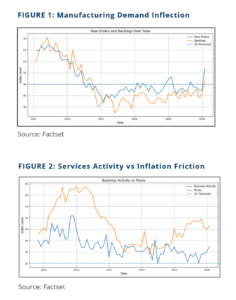
The good news first. Manufacturing activity accelerated to its strongest reading in more than four years, and the strength was broad rather than narrow: new orders, production, order backlogs, and hiring all improved, with fifteen of eighteen industries expanding. At the same time, inflation cooled for a third consecutive month, easing from 4.1% in May to 3.3% in June and 2.9% in July. Growth accelerating while inflation decelerates is the most favorable combination the economy produces, and it moved the business cycle out of the overheating phase it occupied in July.
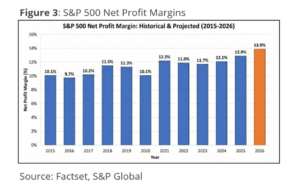
The complication is borrowing costs. In a textbook version of this transition, slower inflation brings interest rates down with it. That is not what happened. The ten-year Treasury yield rose to 4.75%, and because inflation fell at the same time, the inflation-adjusted cost of borrowing jumped from roughly 0.3% to 1.9% in a single month. The economy improved. But the price investors are being asked to pay for future growth became more demanding.
That combination shapes everything below. The expansion is intact and worth participating in. What has changed is how much room there is for error if something disappoints.
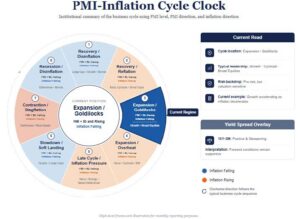
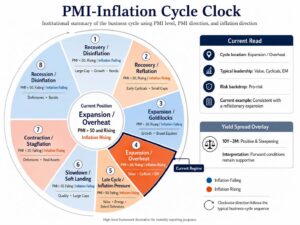
The cycle clock moved from Expansion / Overheat in July to Expansion / Goldilocks in August.
Goldilocks describes the growth-and-inflation mix; it does not mean financial conditions are
What the Market Environment Favors
The backdrop still supports owning equities. It favors a different balance within them than it did three months ago, when growth was strong but inflation was still climbing.
Steadier companies over the most volatile ones: When the cost of capital rises, the market becomes less forgiving of companies whose value depends heavily on profits far in the future. Businesses with more stable earnings and less dramatic price swings tend to hold up better in that environment, without requiring an investor to leave the market.
Reasonably priced companies across all sizes: Value stocks do not require rising inflation to perform. When real interest rates are higher, investors tend to place a greater premium on businesses generating profits today rather than on companies whose valuations depend heavily on earnings far in the future. Spreading that across large, medium, and small companies avoids depending on any single slice of the market.
Energy and defensive sectors together: Energy participates in firm economic activity. Together with consumer staples and utilities, they create a balance between participation in firm economic activity and some resilience if the expansion becomes choppier or rates stay high.
International quality, with more selective emerging market exposure: Developed international markets, particularly higher-quality companies, continue to merit real weight. The model continues to retain broad emerging-market exposure, while becoming more selective at the individual-country level.
What Changed This Month
The most useful thing to understand is what did not change. Overall equity exposure is unchanged, and the US allocation remained at 59.5%. There was no move to cash and no reduction in stock-market participation.
What changed is composition. Within US holdings, the emphasis moved toward lower-volatility companies and toward reasonably priced companies across large, medium, and small sizes. Within international holdings, roughly four and a half percentage points moved from emerging markets toward developed international markets, though broad emerging market exposure itself was left alone. Energy, consumer staples, and utilities all carried over unchanged.
The distinction worth holding onto is this: this month adjusted where risk sits, not how much of it there is. That is a meaningfully different decision from turning cautious, and it reflects an environment where the economy is improving while the price of money is rising.
The Backdrop Behind the Market
The Economic Backdrop
Manufacturing activity rose to 55.6, its highest level since May 2022. Fifteen of eighteen industries expanded, and manufacturing employment moved above the expansion line for the first time in thirty-three months. The strength is broad rather than concentrated in one or two industries.
Inflation moved the other way, easing for a third consecutive month to 2.9%. Growth above the expansion line and rising, combined with inflation falling, is the Goldilocks quadrant of the cycle clock rather than the overheating quadrant the economy occupied in July.
One caveat belongs here. The prices manufacturers pay for their raw materials remain elevated at 71.1, well above the level that signals rising costs. Consumer inflation has cooled, but cost pressure has not disappeared from the production pipeline. This is disinflation at the headline level rather than a fully resolved inflation problem.
Corporate Earnings Remain a Pillar
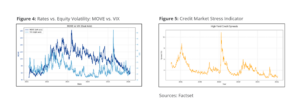
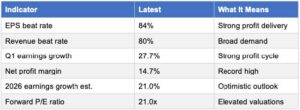
Profits are the strongest single support for equities right now. With 88% of the S&P 500 having reported, 86% beat earnings expectations and 76% beat on revenue. Blended earnings growth reached 50.4% against the 23.1% analysts expected at the end of June, and revenue growth of 15.0% is the strongest since late 2021. All eleven sectors saw estimates revised upward.
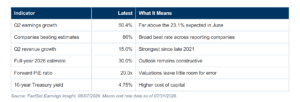
There is an important qualification. A meaningful share of the headline growth comes from a small number of very large technology companies; excluding Alphabet and Amazon reduces both the size of the surprise and the growth rate, though what remains is still strong. The profit cycle is real, but it is not evenly distributed.
Market Conditions Remain Supportive
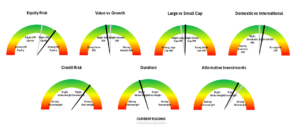
The risk environment is calm. Equity volatility is low with the VIX near 15, corporate borrowing costs are tight relative to government bonds, and dollar liquidity has moved from neutral to easing. These are not the conditions that precede market stress, and market internals confirm it: economically sensitive sectors are outperforming defensive ones in the United States, developed international markets, and emerging markets alike. US cyclical leadership strengthened dramatically, from a negligible advantage in July to nearly fifteen percentage points over six months.
One thing did deteriorate, and it is worth understanding because it is not obvious. Stocks and bonds have started moving together far more than they were: the relationship between them rose from essentially zero to 0.55 over the past month. In practical terms, that means bonds are providing considerably less protection than usual when stocks fall. A jump in interest rates would now likely pressure both at once, which reduces one of the traditional diversification benefits of a balanced stock-and-bond portfolio.
What Could Derail This Setup
The environment is constructive, but the risks have shifted in an important way. Three months ago the main worry was that inflation would keep climbing and force the economy into a downturn. That is no longer the primary concern.
The primary risk scenario: interest rates rising further from here. With stocks trading at 20 times expected earnings and the inflation-adjusted cost of borrowing already up sharply, higher yields would compress valuations directly, and the weakened relationship between stocks and bonds means there would be less cushion than usual. This is a valuation and cost-of-capital risk rather than a recession risk.
Specific warning signs to monitor:
➔ Ten-year Treasury yields moving meaningfully above current levels, pressuring valuations
➔ Inflation reaccelerating, particularly if elevated production costs start feeding into consumer prices
➔ Manufacturing activity rolling over, which would undercut the expansion thesis
➔ Corporate borrowing costs widening, the clearest early sign that calm conditions are breaking
➔ Stocks and bonds moving together even more closely, further reducing the value of diversification
➔ Defensive sectors beginning to outperform economically sensitive ones
➔ Earnings growth narrowing further into a handful of very large companies
There is also a subtler risk in how thoroughly the market has already recognized the good news. Cyclical sectors lead in every major region, credit conditions are tight, and volatility is low. Most of the positive story is now reflected in prices as well as in analyst estimates, which means the market increasingly needs companies to deliver results rather than simply to raise expectations.
The Bottom Line
The economy improved this month in a way that genuinely matters. Growth accelerated and broadened, inflation cooled for a third consecutive month, corporate profits came in far ahead of expectations, and credit markets show no sign of stress. The business cycle moved into its most favorable configuration.
What did not improve is the cost of money. Interest rates rose even as inflation fell, valuations remain demanding at 20 times forward earnings, and bonds are providing less protection than they normally would. The economy got better; the terms on which that economy is priced got tougher.
That combination helps explain why the model’s composition changed without reducing overall equity exposure. The external environment still supports equity participation, while higher real yields, demanding valuations, and weaker stock-bond diversification make the model’s emphasis on steadier companies, explicit value, and international quality economically coherent.
The expansion is not in question. The margin of safety around it is. Interest rates, inflation direction, credit conditions, and the breadth of earnings growth are therefore the key indicators to watch in the months ahead.
IMPORTANT DISCLAIMERS AND DISCLOSURES:
The information contained in this presentation has been gathered from sources we believe to be reliable, but we do not guarantee the accuracy or completeness of such information, and we assume no liability for damages resulting from or arising out of the use of such information. Past performance is not indicative of future results.
The views expressed in the referenced materials are subject to change based on market and other conditions. This document may contain certain statements that may be deemed forward-looking statements. Please note that any such statements are not guarantees of any future performance and actual results or developments may differ materially from those projected. Any projections, market outlooks, or estimates are based upon certain assumptions and should not be construed as indicative of actual events that will occur. The information provided herein does not constitute investment advice and is not a solicitation to buy or sell securities.
Different types of investments involve varying degrees of risk, and there can be no assurance that the future performance of any specific investment, investment strategy, investment model, or products, including the investments, investment strategies or investment themes referenced herein, will be profitable, equal any corresponding indicated historical performance level(s), be suitable for a particular portfolio or individual situation, or prove successful. Due to various factors, including changing market conditions and/or applicable laws, the content may no longer be reflective of current opinions or positions.
Please note that nothing in this content should be construed as an offer to sell or the solicitation of an offer to purchase an interest in any security or separate account. Nothing is intended to be, and you should not consider anything to be direct investment, accounting, tax, or legal advice to any one investor. Consult with an accountant or attorney regarding individual accounting, tax, or legal advice. No advice may be rendered unless a client service agreement is in place.
Procyon Advisors, LLC is a registered investment advisor with the U.S. Securities and Exchange Commission (“SEC”). This report is provided for informational purposes only and for the intended recipient[s] only. This report is derived from numerous sources, which are believed to be reliable, but not audited by Procyon for accuracy. This report may also include opinions and forward-looking statements which may not come to pass. Information is at a point in time and subject to change.
For additional information, please visit our website at www.procyon.net.
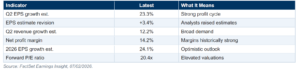


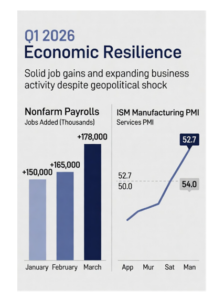 Inflation dynamics evolved meaningfully over the course of the quarter. Early in Q1, headline inflation remained relatively contained, with CPI at 2.4% year-over-year and core PCE around 3.1%. However, the late-quarter oil shock introduced a new source of pressure. Rising energy costs fed through to input prices, contributing to a repricing of inflation expectations and a modest increase in bond yields.
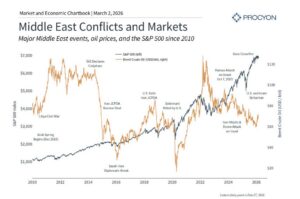
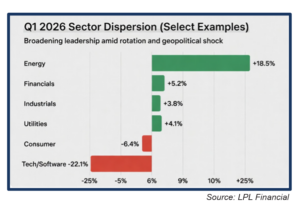
 The late-February Iran conflict escalation and Strait of Hormuz disruptions created a classic supply-shock scenario, spiking oil and commodities while initially pressuring risk assets. Despite this, markets proved resilient: