
Welcome OLV Investment Group clients. We are honored to have you join the Procyon community.


Procyon Tag

Procyon acquires $500m Michigan RIA


Connecticut RIA Procyon revealed one of its largest deals to date on Monday, as the firm continues to scale up since selling a stake to Constellation Wealth Capital (CWC) earlier this year.

Procyon’s deal brings aboard OLV Investment Group, a Flint, Mich.-based RIA overseeing roughly $500m in client assets.

‘By joining forces with OLV, we are extending the reach of our platform to new regions and clients with evolving financial needs,’ Procyon chief executive Phil Fiore stated. ‘This is about applying what we’ve built to serve a wider audience, without ever losing the personal touch that defines us.’

Dynasty-Backed Procyon Acquires $500M OLV Investment Group


Procyon Partners, a registered investment advisor based in Shelton, Conn., that is part of the Dynasty Financial Partners network, has acquired OLV Investment Group, a wealth management firm with over $500 million in client assets and locations in Michigan and Texas.

The deal brings Procyon’s total assets under management to nearly $9 billion and total headcount to nearly 80. The addition also expands Procyon’s presence into the Midwest and South, bringing on seven new advisors and 13 team members. 

What Makes an RIA Attractive to Acquirers? There’s No Simple Answer.


Harris Baltch

Phil Fiore, CEO, Procyon: What I look for, most important, is an acquisition target that believes that we, as a collective, are better together. If they believe a deal is just about them making us better, or just about us making them better, then that would be a significant cultural disconnect.

They need to eliminate the “this is our team” approach. At Procyon we have a “one team one dream” approach and we don’t have silos. So, adapting to that philosophy is a major component of any deal.

Benefits Think Why more employers are embracing total benefits consulting


As the lines between  financial wellness and physical well-being continue to blur in today’s workplace, employers are rethinking how they deliver employee benefits. The result is a growing shift toward the total benefits consulting (TBC) model, an approach that unites all aspects of benefits strategy under one integrated advisory team.

Third Quarter in Review:

  • US equities moved higher in the quarter and are now up substantially year to date.
    • Within large caps, the S&P 500 was up 8.1% in the quarter and now up 14.8% year to date.
    • Small cap stocks were even stronger in the quarter, up 12.4%, but continue not trail large cap stocks this year.
  • International equities continued to perform extremely well with a tailwind of the weakening US dollar. These names were up 7% in the quarter and now up 26.6% year to date.
  • Fixed income markets produced nice returns as well, with taxable bonds up 2% and municipal bonds up 3% in the quarter. Year to date, taxable bonds have outpaced municipal by 350bps (6.13% vs 2.64%) as municipals have ran into technical headwinds.
  • The rally we have experienced over the last five months (since the tariff-related market sell-off) has been strong and wide range. In the rest of this write-up, we hope to outline our views on current economic data and our expectations going forward.


Economic Growth — Stabilizing, but still below trend

  • The U.S. economy shows early signs of bottoming, though expansion is not yet broad-based.
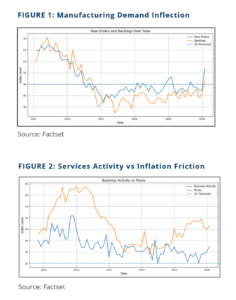
  • Manufacturing PMI edged up to 49.1, its highest in eight months, signaling slower contraction.
    • Production moved back into expansion (51.0), but new orders (48.9) remain weak, pointing to uneven demand.
    • Backlogs and exports remain soft, suggesting a late-downturn / early-recovery phase.
  • Services PMI held near 50.0, signaling stagnation. Business activity cooled, and hiring slowed, while prices (69.4) remained elevated — evidence that inflation pressures persist even as growth moderates.
  • Bottom Line: growth momentum is stabilizing, but the U.S. remains below trend and dependent on liquidity support.


Inflation — Re-accelerating and not yet re-anchored

  • Headline CPI has firmed to 2.9% year-over-year, with core CPI around 3.1%, driven by sticky shelter costs and new tariff effects.
  • The short-term annualized pace (3.5–3.7%) signals an inflation upswing, complicating the Fed’s easing trajectory.
  • Price pressures are most evident in services and housing, while goods inflation remains subdued.
  • Bottom Line: inflation has plateaued above the Fed’s comfort zone – it’s falling, but not fast enough to rule out policy risk.


Federal Reserve Policy — Transitioning from restrictive to reactive

  • The Fed funds rate, near 4.0%, remains modestly restrictive in real terms but is moving toward a data-dependent easing stance.
  • The yield curve (10Y–3M) has finally turned positive (+0.14%) after two years of inversion — a potential late-cycle pivot that historically signals recession risks are fading.
  • Markets expect further cuts into 2026, but that depends on the trajectory of inflation.
  • Bottom Line: policy risk remains two-sided; if inflation stalls above 3.5%, cuts could pause; if growth weakens again, cuts may accelerate.


Market Behavior — Liquidity overtaking fundamentals

  • Despite soft macro data, U.S. equities continue to rally. The S&P 500 hit record highs (6,740), driven by AI-related mega-cap strength and expectations of policy easing.
  • As shown in Bloomberg’s AI network chart, OpenAI, Nvidia, Microsoft, Oracle, and AMD form a dense investment web — billions in cross-investments, GPU spending, and cloud deals are reinforcing a liquidity-driven growth narrative even as real economic indicators lag.


(Bloomberg AI Investment Network — October 2025)


    • Nvidia has pledged up to $100 billion in OpenAI.
    • OpenAI struck a $300 billion cloud deal with Oracle and is deploying 6 GW of AMD GPUs.
    • Microsoft, Oracle, and others are deeply embedded across both the hardware and software layers of the AI economy.
  • This ecosystem has become the core engine of equity market capitalization growth, with the AI “infrastructure trade” supporting valuations even as underlying profits flatten.


Earnings and Valuation — Narrow, expensive, and fragile

  • S&P 500 forward P/E stands at ~23x, near post-COVID highs, supported by rate-cut expectations rather than strong earnings growth.
  • Free cash flow yield is near record lows at ~2%, below investment-grade bond and Treasury yields — implying a compressed equity risk premium.
  • Earnings concentration remains extreme:
    • The “Mag7” account for ~33% of market cap but only ~25% of EPS (OP/MKT ≈ 0.77).
    • Financials, Energy, and Communication Services are over-earning relative to size, while Tech’s earnings share lags its valuation weight.
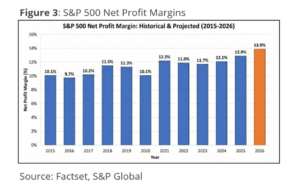
  • With PMIs below 50 and margins peaking, equities are vulnerable to multiple compression if growth or earnings disappoint.


Risk Environment — Improving tone, fragile balance

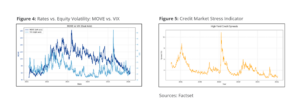
  • Our proprietary risk composite shows a mild uptick (+0.64), signaling rising but contained risk.
  • Volatility and liquidity metrics have improved since Q2, but policy and geopolitical uncertainty remain dominant.
  • Financial markets are loosening ahead of policy, with equities and credit spreads reflecting early-recovery optimism, even as credit growth and small business lending stay weak.


Why Markets Rally Despite Late-Cycle Signals

  1. Markets lead the economy — investors are pricing an early recovery 6–9 months ahead.
  2. Liquidity beats macro — easing and slower quantitative tightening lowers discount rates, inflating valuations.
  3. Performance chasing — defensive managers are re-risking amid FOMO-driven rallies.
  4. Narrative power — the “Soft Landing + AI Productivity + Fed Put” story coupled with a stock market motivated government, keeps sentiment high.
  5. Valuation-driven rally — EPS growth is flat, but higher P/Es lift index levels, echoing prior “liquidity repricing” cycles (1995, 2019).


Our Outlook — Policy-led stabilization with valuation risk

  • Base case: sub-trend growth (~1.5–2.0%), mild disinflation, and ongoing Fed easing into 2026.
  • Best case: inflation falls faster, enabling more cuts and sustained AI-led capex momentum.
  • Risk case: inflation re-accelerates; yield curve steepens for the wrong reasons (higher term premia).
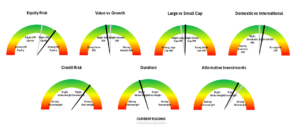
  • Positioning view:
    • We remain constructive but cautious given valuations.
    • We prefer quality balance sheets and cash flow visibility over speculative beta.
    • We are watching for data reversion once shutdown-delayed releases resume.


In short:

  1. Markets are celebrating rate cuts and AI optimism, not broad economic strength.
  2. Growth is stabilizing but fragile; inflation is sticky; policy is reactive; valuations are stretched.
  3. When real data resumes, volatility could rise as sentiment meets fundamentals.


Sources:

Procyon Macro & TAA Review; Bloomberg; Reuters; Federal Reserve

Growth-Minded FAs Look Beyond AUM to Divvy Up Clients


Financial advisors have traditionally relied on clients’ asset amounts to determine service levels, but some are considering other factors, such as complexity and profession, to create their all-important client tiers. Client segmentation is a key practice of advisors who grow sustainably regardless of market conditions, according to a study from LPL Financial.

Alpha Quant® Core Equity is a portfolio of about 50-60 large-cap stocks that exhibit a combination of higher return on invested capital, stronger free cash flow generation, and lower debt leverage compared to the benchmark and peers. The portfolio is managed with a fundamentally based, systematic process with quarterly rebalancing to maintain the portfolio’s focused fundamental profile.

Alpha Quant® Dividend Equity is a focused portfolio consisting of 30 large-cap stocks with strong dividend persistence. The portfolio invests in companies that not only offer high yield, but also have characteristics indicative of strong dividend growth potential. The portfolio is managed with a fundamentally based, systematic process with quarterly rebalancing to maintain the portfolio’s focused fundamental profile.

Alpha Quant® Large Cap Growth

Alpha Quant Large Cap Growth is a high-conviction, high-quality portfolio consisting of 20 stocks that demonstrate sustainable profitability and strong growth fundamentals. The strategy focuses primarily on large-cap stocks, with the flexibility to include select mid-cap holdings. The portfolio typically exhibits superior profitability, measured by return on invested capital and higher projected long-term EPS growth compared to its benchmark and peers. It is managed using a fundamentally driven, systematic process with quarterly portfolio adjustments to maintain its focused fundamental profile.

Alpha Quant® Mid Cap portfolio is a multi-strategy portfolio that combines distinct systematic sub-strategies across mid-capitalization quality and value investment styles. The portfolio is comprised of mid-cap stocks selected based on profitability, valuation, low debt and strong cash flows. The strategy is built bottom-up and diversified across sectors and industries.

The portfolio is managed with a fundamentally based, systematic process with portfolio adjustments and annual rebalancing to equal weight to maintain the portfolio’s focused fundamental profile.

Alpha Quant® Mid Cap Growth portfolio is a multi-strategy, systematic portfolio that invests in companies with high profitability and strong cash flows. The strategy aims to select profitable companies with sustainable earnings growth. The strategy is built bottom-up and diversified across sectors and industries.

The portfolio is managed with a fundamentally based, systematic process with portfolio adjustments and annual rebalancing to equal weight to maintain the portfolio’s focused fundamental profile.

Alpha Quant® Mid Cap Quality portfolio is a systematic strategy that selects companies with high return on invested capital, strong cash flows, and high productivity. The strategy aims to select profitable companies with sustainable earnings growth. The strategy is built bottom-up and diversified across sectors and industries.

The portfolio is managed with a fundamentally based, systematic process with portfolio adjustments and annual rebalancing to equal weight to maintain the portfolio’s focused fundamental profile.