
Welcome OLV Investment Group clients. We are honored to have you join the Procyon community.


Procyon Tag

Third Quarter in Review:

  • US equities moved higher in the quarter and are now up substantially year to date.
    • Within large caps, the S&P 500 was up 8.1% in the quarter and now up 14.8% year to date.
    • Small cap stocks were even stronger in the quarter, up 12.4%, but continue not trail large cap stocks this year.
  • International equities continued to perform extremely well with a tailwind of the weakening US dollar. These names were up 7% in the quarter and now up 26.6% year to date.
  • Fixed income markets produced nice returns as well, with taxable bonds up 2% and municipal bonds up 3% in the quarter. Year to date, taxable bonds have outpaced municipal by 350bps (6.13% vs 2.64%) as municipals have ran into technical headwinds.
  • The rally we have experienced over the last five months (since the tariff-related market sell-off) has been strong and wide range. In the rest of this write-up, we hope to outline our views on current economic data and our expectations going forward.


Economic Growth — Stabilizing, but still below trend

  • The U.S. economy shows early signs of bottoming, though expansion is not yet broad-based.
  • Manufacturing PMI edged up to 49.1, its highest in eight months, signaling slower contraction.
    • Production moved back into expansion (51.0), but new orders (48.9) remain weak, pointing to uneven demand.
    • Backlogs and exports remain soft, suggesting a late-downturn / early-recovery phase.
  • Services PMI held near 50.0, signaling stagnation. Business activity cooled, and hiring slowed, while prices (69.4) remained elevated — evidence that inflation pressures persist even as growth moderates.
  • Bottom Line: growth momentum is stabilizing, but the U.S. remains below trend and dependent on liquidity support.


Inflation — Re-accelerating and not yet re-anchored

  • Headline CPI has firmed to 2.9% year-over-year, with core CPI around 3.1%, driven by sticky shelter costs and new tariff effects.
  • The short-term annualized pace (3.5–3.7%) signals an inflation upswing, complicating the Fed’s easing trajectory.
  • Price pressures are most evident in services and housing, while goods inflation remains subdued.
  • Bottom Line: inflation has plateaued above the Fed’s comfort zone – it’s falling, but not fast enough to rule out policy risk.


Federal Reserve Policy — Transitioning from restrictive to reactive

  • The Fed funds rate, near 4.0%, remains modestly restrictive in real terms but is moving toward a data-dependent easing stance.
  • The yield curve (10Y–3M) has finally turned positive (+0.14%) after two years of inversion — a potential late-cycle pivot that historically signals recession risks are fading.
  • Markets expect further cuts into 2026, but that depends on the trajectory of inflation.
  • Bottom Line: policy risk remains two-sided; if inflation stalls above 3.5%, cuts could pause; if growth weakens again, cuts may accelerate.


Market Behavior — Liquidity overtaking fundamentals

  • Despite soft macro data, U.S. equities continue to rally. The S&P 500 hit record highs (6,740), driven by AI-related mega-cap strength and expectations of policy easing.
  • As shown in Bloomberg’s AI network chart, OpenAI, Nvidia, Microsoft, Oracle, and AMD form a dense investment web — billions in cross-investments, GPU spending, and cloud deals are reinforcing a liquidity-driven growth narrative even as real economic indicators lag.
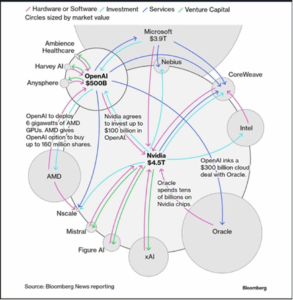
 

(Bloomberg AI Investment Network — October 2025)


    • Nvidia has pledged up to $100 billion in OpenAI.
    • OpenAI struck a $300 billion cloud deal with Oracle and is deploying 6 GW of AMD GPUs.
    • Microsoft, Oracle, and others are deeply embedded across both the hardware and software layers of the AI economy.
  • This ecosystem has become the core engine of equity market capitalization growth, with the AI “infrastructure trade” supporting valuations even as underlying profits flatten.


Earnings and Valuation — Narrow, expensive, and fragile

  • S&P 500 forward P/E stands at ~23x, near post-COVID highs, supported by rate-cut expectations rather than strong earnings growth.
  • Free cash flow yield is near record lows at ~2%, below investment-grade bond and Treasury yields — implying a compressed equity risk premium.
  • Earnings concentration remains extreme:
    • The “Mag7” account for ~33% of market cap but only ~25% of EPS (OP/MKT ≈ 0.77).
    • Financials, Energy, and Communication Services are over-earning relative to size, while Tech’s earnings share lags its valuation weight.
  • With PMIs below 50 and margins peaking, equities are vulnerable to multiple compression if growth or earnings disappoint.


Risk Environment — Improving tone, fragile balance

  • Our proprietary risk composite shows a mild uptick (+0.64), signaling rising but contained risk.
  • Volatility and liquidity metrics have improved since Q2, but policy and geopolitical uncertainty remain dominant.
  • Financial markets are loosening ahead of policy, with equities and credit spreads reflecting early-recovery optimism, even as credit growth and small business lending stay weak.


Why Markets Rally Despite Late-Cycle Signals

  1. Markets lead the economy — investors are pricing an early recovery 6–9 months ahead.
  2. Liquidity beats macro — easing and slower quantitative tightening lowers discount rates, inflating valuations.
  3. Performance chasing — defensive managers are re-risking amid FOMO-driven rallies.
  4. Narrative power — the “Soft Landing + AI Productivity + Fed Put” story coupled with a stock market motivated government, keeps sentiment high.
  5. Valuation-driven rally — EPS growth is flat, but higher P/Es lift index levels, echoing prior “liquidity repricing” cycles (1995, 2019).


Our Outlook — Policy-led stabilization with valuation risk

  • Base case: sub-trend growth (~1.5–2.0%), mild disinflation, and ongoing Fed easing into 2026.
  • Best case: inflation falls faster, enabling more cuts and sustained AI-led capex momentum.
  • Risk case: inflation re-accelerates; yield curve steepens for the wrong reasons (higher term premia).
  • Positioning view:
    • We remain constructive but cautious given valuations.
    • We prefer quality balance sheets and cash flow visibility over speculative beta.
    • We are watching for data reversion once shutdown-delayed releases resume.


In short:

  1. Markets are celebrating rate cuts and AI optimism, not broad economic strength.
  2. Growth is stabilizing but fragile; inflation is sticky; policy is reactive; valuations are stretched.
  3. When real data resumes, volatility could rise as sentiment meets fundamentals.


Sources:

Procyon Macro & TAA Review; Bloomberg; Reuters; Federal Reserve

Growth-Minded FAs Look Beyond AUM to Divvy Up Clients


Financial advisors have traditionally relied on clients’ asset amounts to determine service levels, but some are considering other factors, such as complexity and profession, to create their all-important client tiers. Client segmentation is a key practice of advisors who grow sustainably regardless of market conditions, according to a study from LPL Financial.

DUE DILIGENCE REPORT – LARGE CAP US EQUITIES

September 26, 2025
By Jen Hill  


Although the US economy has been resilient, the effect of higher rates and trade wars has not been evenly distributed. The concentrations of both capital investment and subsequent earnings continue to build in the tech sector despite a stricter borrowing environment and more difficult global trade.

We see the S&P, NASDAQ and DOW all hitting record highs, home prices hitting all-time highs, bitcoin and gold, all at all-time highs and CPI sitting at 2.9% over the last twelve months. What would cause the fed and US investors to ask for rate cuts? The fed appears to remain focused on their dual mandate of full employment and moderate inflation.


Employment softening: Bouncing from historic low unemployment, but with a clear trend.

  • Unemployment at 4-year high, 4.3%
  • Downward revision of 911k less jobs created over 12 months period ending 3/31/25.
  • Job creation for August was 22k, a sharp decline from previous months.
  • Firms most affected by higher rates and tariffs are smaller companies who are finding it difficult to hire.


Inflation: Sticky but under control.

  • CPI is up 2.9% over the last 12 months
  • Shelter & Food – Biggest drivers of inflation over the past year, with rising rents and higher prices for meats, poultry, and dining out.
  • Energy & Services – Mixed impact: gasoline fell, but electricity, natural gas, and healthcare costs added pressure

As the fed governors debate these points internally, they have decided to cut the target fed funds rate by .25% to a new target of 4.00-4.25%. The signal from Chair Jerome Powell is that the fed’s goal of full employment has shifted in importance versus inflation in the last few months, and that going forward more cuts are expected.

The fed’s reaction to the softening labor market should be encouraging to workers and investors as it shows confidence that inflationary pressures have largely passed and they can count on full-on support for labor in the near-term.


Sources:

Bureau of Labor Statistics: https://www.bls.gov/cpi/
Y Charts: https://ycharts.com/


Top tips for young financial advisors

July 30, 2025 by Suleman Din and Bernice Napach

Take the uphill challenge of building a book of business from scratch.

You’ve leveraged your network of friends and family, and now you’re stretching to cut through the noise of everyday digital distractions to impress prospects. You’re in an advisory firm trying to learn from the same seasoned professionals you’re hoping to impress. You’re also gaining hands-on experience in the industry’s complexity and learning how to comply with its regulatory requirements.

Looking back on their beginnings in the business, several advisors say that young professionals can build a successful practice with less pain by honing their communication skills, pursuing continuous education, cultivating a solid network, and prioritizing integrity.

They’ve shared their top tips with Action! Magazine to help young financial advisors establish themselves as credible, reliable and knowledgeable professionals ready to guide clients through their financial journeys confidently and clearly.

Veteran women advisors offer career advice to up-and-comers

July 22, 2025

Women represent 31% of US financial advisors at last check, according to the Bureau of Labor Statistics (BLS). That means they have a lot of room for growth in the wealth management industry, especially for young female advisors getting started.

But wait! There’s more good news for up-and-coming women advisors!

The next generation of female advisors will also have a huge advantage when accumulating assets in the coming years. Studies show women will inherit the majority of the $124 trillion in Baby Boomer and Gen X wealth set to be transferred over the course of the next two decades, and many of those wealth inheritors will be solely seeking to connect with female advisors who better understand their financial and career circumstances.

So what are veteran female advisors telling the new generation of women wealth managers to prepare them for this brave new world?

Procyon buys $600m Connecticut RIA in first deal post-Constellation investment

July 8, 2025

On the surface, the second quarter of 2025 was a blockbuster quarter for equity markets. U.S. and international equities surged over 10%, driven by a powerful rally that took hold in April and rarely let up. Small caps lagged but still posted a solid 8.5% gain.

Taxable fixed income finished slightly positive, while municipals drifted modestly lower.

If you only looked at the numbers, you’d assume investors spent the quarter embracing risk with confidence. But markets rarely move in straight lines—and this quarter’s strength masked a rollercoaster of volatility, uncertainty, and geopolitical shock. While the final story is written above, the chapters that follow offer deeper perspective on what shaped Q2 and where we go from here.

Chapter 1: Tariffs Return with a Vengeance (and So Does Volatility)

The tone for Q2 was set even before it officially began. Markets spent much of Q1 trading lower in anticipation of a shift in U.S. trade policy, and on April 2nd, those fears were realized. In a dramatic speech, former President Trump declared “Liberation Day,” where he announced sweeping tariffs on nearly all imports from countries where the U.S. ran a trade deficit.

Markets responded sharply. U.S. equities plunged, with the S&P 500 dropping nearly 19% from its February peak to the early April trough. The VIX (volatility index) spiked above 50—levels not seen since the pandemic panic of 2020. International markets held up slightly better thanks to a weaker U.S. dollar, but still fell close to 14% from their highs.

The sudden shift in trade policy not only rattled markets—it created deep uncertainty for business leaders and research analysts. With little clarity on the scope or duration of tariffs, many companies began pausing investment plans. We expect these effects to echo through the second half of the year as firms reevaluate capital allocation and supply chain strategies.

Chapter 2: A Pause, Progress, and Promises

Just one week after Liberation Day, the narrative shifted again. On April 9th, President Trump surprised markets by announcing a 90-day pause on the newly announced tariffs. The move was framed as a goodwill gesture to allow space for ongoing trade negotiations, some of which had begun bearing fruit behind the scenes.

The market response was euphoric. The S&P 500 experienced its strongest single-day rally in years, and risk appetite returned with force. From the trough on April 8th to the end of the quarter, major equity indices climbed over 24%.

The 90-day pause was not a resolution, but it was a release valve. It gave markets breathing room and helped anchor the view that extreme trade policy outcomes may be used more for leverage than legislation. While risks remain, investors grew increasingly confident that future tariff headlines would be more bark than bite. That being said, baseline tariffs of 10% remain in place and will have impact on earnings and business investment going forward.


Chapter 3: Powell Holds in the Face of Political Pressure

Coming into the year, markets were pricing in rate cuts by mid-2025. But strong labor market data (unemployment at 4.1%) and inflation that remained above target (Core PCE at 2.7%) kept the Fed firmly on hold.

Chairman Powell and the FOMC opted to stay patient, resisting growing political pressure from President Trump, who has been vocally critical of the Fed’s hesitancy to cut. The Fed’s stance remained cautiously restrictive, aiming to keep inflation on its path toward 2% without jeopardizing the broader economy.

With policy uncertainty (especially on trade and fiscal fronts) still swirling, a wait-and-see attitude is appropriate. The Fed continues to hold a slightly restrictive policy stance, which we believe is appropriate given the economic conditions. Going forward, the Fed finds itself walking a tightrope—balancing economic resilience with political noise, and data dependency with global risk factors.


Chapter 4: Missiles Fly, Markets Hold

Perhaps the most surprising chapter of Q2 came in mid-June, when geopolitical tensions flared dramatically. Israel launched coordinated strikes on Iranian nuclear sites, followed days later by a U.S. air campaign coined Operation Midnight Hammer.

Oil prices surged more than 10% overnight, and headlines warned of a broader regional war. But markets barely blinked. Iran threatened retaliation but ultimately refrained, as President Trump brokered a ceasefire that de-escalated tensions.

By quarter’s end, energy prices had fully retraced their gains, and equities continued their march higher. The market’s muted reaction was a testament to investor focus on fundamentals and a belief that the conflict would remain contained. It was also a reminder of one of our core beliefs: time in the market beats timing the market.


Epilogue: The Story Continues

We’ve already seen significant developments in the early days of Q3. Most notably, the Big Beautiful Bill—a sweeping piece of fiscal legislation—was signed into law on July 4th. The bill includes tax cuts, infrastructure spending, and energy policy changes, and while its full impact will take time to unfold, it’s expected to add meaningfully to the national debt.

The bill comes after Moody’s downgraded the U.S. credit rating in Q2—a sign that debt levels are beginning to catch up with fiscal optimism. As a result, we anticipate higher rates on the long end of the yield curve. The curve remains slightly inverted, but we expect a combination of modest Fed cuts and rising long-term yields to push it toward normalization in the months ahead.

From a macro perspective, we remain constructive. Inflation is moderating, employment remains tight, earnings are resilient, and financial conditions are stable. A more accommodative central bank paired with pro-growth policy may continue to support risk assets. But with rising divergence across market caps, sectors, and styles, selectivity matters more than ever.


Our Positioning

We continue to emphasize broad diversification as essential tools in this market:

  • International equities have shown long-awaited leadership after a decade of underperformance.
  • Value stocks led early in the year, but growth roared back after April’s lows.
  • Small caps still trail, but falling rates and tax relief could act as a catalyst.
  • Fixed income has played its role as portfolio ballast during equity drawdowns, particularly in March and early April.

Passive index exposure and concentrated sector/company bets may have worked in recent years—but going forward, we see growing risk in narrow exposures. Discipline, diversification, and a long-term view remain your greatest allies in this fast moving market environment.

DUE DILIGENCE REPORT – SMALL AND MID-CAPS

June  26, 2025
By Jen Hill  

Strategic Macro Themes: Navigating a Shifting Global Landscape

As global capital flows continue to realign across economies and corporate balance sheets, our team is closely tracking several critical macroeconomic and geopolitical developments. Below is a summary of the key themes shaping our strategic outlook:

Trade Realignments and the “Chexit” Era

Shift Away from China

The U.S. has significantly reduced direct trade with China, redirecting flows to countries such as Mexico, Vietnam, and India. These nations increasingly serve as intermediaries in supply chains that still rely on Chinese components.
In response, China is deepening trade ties with emerging markets across Africa, Latin America, and Southeast Asia to diversify away from Western markets.

Rise of Economic Nationalism

In 2025, the U.S. imposed sweeping new tariffs1:

  • 30% on most Chinese imports, with exceptions like smartphones at 20%.
  • 25% on steel, aluminum, and non-USMCA-compliant goods from Mexico and Canada.
  • 10% baseline tariffs on most other imports, including from the EU.

These tariffs are framed as reciprocal and based on trade deficit ratios, not purely retaliatory.
Legal challenges were initially successful, but an emergency appeal reinstated the tariffs.

Friendshoring and Nearshoring

Supply chains are increasingly relocating to politically aligned nations. The EU is expanding trade with the U.S., ASEAN, and Africa while reducing reliance on Russia and China.

Fragmentation of Global Trade

The global trade system is becoming more fragmented and opaque. Regional trade blocs and indirect trade routes are replacing traditional global supply chains, resulting in higher costs, investment delays, and reduced transparency.

Strategic Sectors Under Pressure
  • Critical sectors such as semiconductors, industrial production, and critical minerals are at the center of these realignments.
  • The U.S. and EU are investing heavily in domestic capabilities, while China is securing long-term supply contracts with resource-rich nations.


→ Strategic Outlook: We are adopting a globally diversified and defensively postured approach to navigate the volatility and complexity of evolving supply chains.

Global Technological Competition

U.S. / China Rivalry

The U.S. and China remain locked in a high-stakes race for technological supremacy in AI, semiconductors, and quantum computing. Both nations are investing aggressively in domestic innovation while restricting cross-border tech flows.

Green Tech and Strategic Autonomy

The EU is leading in green technology, while the U.S. and China compete over battery supply chains and clean energy infrastructure. Reshoring is accelerating as nations seek to reduce dependence on geopolitical rivals.

Emerging Tech Hubs and Space Innovation

Countries such as India, South Korea, and Brazil are emerging as influential tech players. Meanwhile, space technology is becoming a new frontier, with both public and private entities expanding satellite and lunar initiatives.


 Strategic Outlook:  The U.S. regulatory landscape is evolving rapidly to support competitiveness in the global tech ecosystem. Our focus is on understanding how firms are positioning themselves in this dynamic race.


“Big Beautiful Bill” – U.S. Fiscal and Tax Policy Update

Passed by the House on May 22, 2025, and currently under Senate review, the bill includes several impactful provisions:

Extension of TCJA Provisions
  • Permanently extends lower individual tax rates and the doubled standard deduction from the 2017 Tax Cuts and Jobs Act.
  • Maintains high estate tax exemptions and limits on mortgage interest and itemized deductions.


New Deductions and Credits
  • Introduces temporary deductions for tips, overtime, auto loan interest, and a larger standard deduction for seniors.
  • Expands credits for child care, paid family leave, adoption, and education.


Business and Investment Incentives
  • Restores 100% bonus depreciation and expands pass-through business deductions.
  • Enhances tax benefits for small businesses, manufacturers, and Opportunity Zones.


Health and Savings Reforms
  • Expands Health Savings Accounts (HSAs) and codifies CHOICE health reimbursement arrangements.
  • Adds employer incentives and adjusts eligibility for premium tax credits.


Revenue Offsets and Fiscal Impact
  • Introduces new limits on SALT deductions, nonprofit tax rules, and international tax enforcement.
  • Projected to increase the federal deficit by $2.4–$3.8 trillion over 10 years 2, with tariff revenue cited as a key offset.


 Strategic Outlook:  We anticipate further amendments before a Senate vote. The broader implication is a continued reliance on deficit financing to support government initiatives, which may influence long-term fiscal sustainability and market sentiment.


Sources:

May 23, 2025

To mark this national holiday, wealth management professionals share insights they gained during their years of service and how they are helping military families today.

By Sally Cates

At Dynasty Financial Partners, we recognize this day with intention. We strive to remember that behind every freedom we enjoy is a name, a family, and a story of sacrifice. While I’m not a financial advisor myself, my role allows me to support a network of advisors who serve a wide range of clients, including veterans, military spouses, and Gold Star families. It’s a way for me to continue serving—just in a different uniform.

Flexibility is especially important given the complex and often underappreciated financial realities military families face: lower base pay, frequent relocations, deployments that interrupt spousal careers, and a veterans benefits system that can be difficult to navigate. Lead with empathy, and be curious. Learn the language of the military—it helps build trust. Most importantly, educate yourself on military-specific financial tools and benefits so you can offer meaningful, tailored advice.

Jeff Farrar, chief operating officer, managing director, Procyon: How did your experience as a service member influence the way you approach financial planning?

It taught me the value of hard work (“Get up early and get at it”), adaptability and flexibility. You learn to quickly process the required information and get to 90% of the required information as fast as possible. The military developed OODA loop comes to mind. Observe, Orient, Decide, and Act comes to mind. It helps folks make faster, more effective decisions in complex situations.

I learned to work with all kinds of people from varied backgrounds. And to remain calm under pressure. That helps when dealing with a rapidly evolving uncertain market environment and trying to provide calm leadership to clients.

Active duty service members, veterans, or surviving spouses typically are asset poor and pension rich. They don’t make a ton of income but can retire young. Many also have some sort of disability pay which needs to be planned for. And helping them navigate the Military benefits when they retire versus other options allows us to add value. Many service people don’t fully “retire” when they stop working on active duty so we can help them think about what is different as they enter the civilian workforce with its own jargon and systems.

Andy Leung, vice president, private wealth advisor, Procyon: What did you learn from your military experience that influences your approach to financial planning?

When it comes to proper planning, the Marine Corps uses a five-paragraph order for military operations: Situation, Mission, Execution, Administration and Logistics, and Command and Signal. This is similar to a financial plan and the objective is a successful retirement.

We work with many veterans as clients but additionally we do pro bono work for veterans who ask for help. It has been great to work with these veterans who may have fallen on hard times. We help with pensions, disability, education benefits, etc. Veterans like structure so it is great to help them create that in their financial life. It is really gratifying to help clients and families who have served and have a common bond.

Mark Perrault, president, managing partner, Intergy Private Wealth: How does your firm recognize Memorial Day? Can you share an example when you supported a military family?

Some of us participate with our families in an Angel Run 5K, which I am doing with my kids. All proceeds will be donated to Angels of America’s Fallen to help accomplish their mission of supporting children of fallen firefighters, military, and law enforcement personnel through activities such as sports, music, and other arts.

We have the ability to do financial planning for military personnel since two advisors have served and two of our team members are/have been military spouses. We understand the benefits veterans receive. In one case, we knew before the family did that as a vet there was a Veterans Affairs benefit called Aid and Attendance. We were able to help the family secure that for an aging parent who was a vet.

We have also been able to help quite a few active duty military officers decide whether to stay in or get out of the military, yet remain reservists. That has helped some families be more in control of where they live without sacrificing financial security. Sadly, an advisor on my team lost his best friend from West Point who had served 10 years. We helped the surviving spouse with two kids navigate life after the death and put together her whole financial plan. To be able to show her just how much financial security she had because of her husband’s service was amazing.

Sally Cates is a managing director and is responsible for public relations and communications for Dynasty Financial Partners and the Dynasty Network of Advisors. Previously, she led global communications at Citi Private Bank and Smith Barney.

FRAGILE FOUNDATIONS: TARIFF POLICY AND THE DIVERGENCE IN MARKET EXPECTATIONS

We’re pleased to share the May 2025 edition of Equity Insight. In this update we explore recent developments in tariff policy, market volatility, corporate earnings, and the evolving outlook for investor sentiment.

From shifting trade dynamics to signs of market stabilization, this piece offers timely insights into what’s driving today’s investment landscape. Please click below to access the full report.

Enjoy the read.